
Condylostylus leonardi
(Van Duzee, 1914)
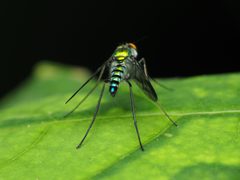
A small predatory long-legged fly in the Dolichopodidae, described by Van Duzee in 1914. Like other members of its , it exhibits the characteristic metallic coloration and elongated legs typical of dolichopodids. The is part of a large and diverse family of flies known for their agility and predatory habits on other small insects.
Pronunciation
How to pronounce Condylostylus leonardi: /ˌkɒn.dɪ.loʊˈstaɪ.ləs liˈɒn.ər.daɪ/
These audio files are automatically generated. While they are not always 100% accurate, they are a good starting point.
Identification
Difficult to distinguish from other Condylostylus without examination of male genitalia. Species-level identification generally requires dissection and microscopic examination of male terminalia. The Condylostylus can be recognized by the combination of metallic coloration, long legs, and predatory on foliage in sunny .
Images
Habitat
Gardens, forest edges, and similar open sunny with vegetation. Found on foliage where it actively hunts prey.
Distribution
North America; specific records include Illinois (Skokie). Distribution details beyond type locality and scattered observations are not well documented.
Seasonality
Active during warmer months when prey is abundant; specific not documented for this .
Diet
Predatory on other small insects. Prey captured using modified —an extendable lower 'lip' with opposable lobes that crush or tear victims.
Life Cycle
Larval stage presumed aquatic or semi-aquatic based on characteristics, though specific details for this are unknown. are the most commonly observed life stage.
Behavior
Highly active and rarely stationary, making observation and photography difficult. Rapid, darting movements over leaves in sunny spots. Sensitive to disturbance and camera pre-flash, often fleeing before image capture. Males perform complex courtship dances using ornamented front to display to females.
Ecological Role
of small insects; contributes to regulation of of other small arthropods in garden and forest edge . Potential agent in garden settings.
Human Relevance
Valued as a garden ally due to predatory habits on pest insects. Subject of interest for macrophotography enthusiasts, though challenging to capture due to rapid movement and sensitivity to disturbance. No known negative impacts on humans.
Similar Taxa
- Other Condylostylus speciesNearly indistinguishable without male genitalia examination; share metallic coloration, preferences, and
- Dolichopus speciesAlso long-legged with metallic coloration, but males possess scaled ornaments on front used in courtship; some found on water surface
- Hydrophorus speciesSkate across water surfaces like water striders; occupy different microhabitat despite similarities
- Medetera species'Woodpecker flies' found on tree trunks in characteristic tiptoe posture; differ in use from foliage-dwelling Condylostylus
More Details
Taxonomic note
identification in Condylostylus and the Dolichopodidae generally requires examination of male genitalia. The family contains approximately 1,300 species in 60 in North America north of Mexico, making it one of the most diverse fly families.
Morphological specialization
Unlike robber flies (Asilidae) or dance flies (Empididae), dolichopodids lack beak-like mouthparts. Instead, they possess a highly modified capable of crushing prey, an for at small body size.