
Condylostylus banksii
(Van Duzee, 1914)
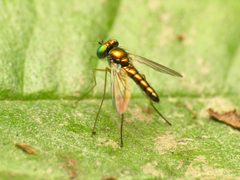
Condylostylus banksii is a of long-legged fly in the Dolichopodidae, first described by Van Duzee in 1914. Like other members of its , it is a small, predatory fly typically found in sunny, vegetated . The species exhibits the family's characteristic metallic coloration and elongated legs. Species-level identification within Condylostylus generally requires examination of male genitalia.
Pronunciation
How to pronounce Condylostylus banksii: //ˌkɒn.dɪ.loʊˈstaɪ.ləs ˈbæŋk.si.aɪ//
These audio files are automatically generated. While they are not always 100% accurate, they are a good starting point.
Identification
Condylostylus banksii can be distinguished from other Condylostylus only through examination of male genitalia, specifically the claspers and associated structures at the tip of the . The Condylostylus is characterized by metallic green, , or bronze coloration, elongated legs, and a body length typically under 5 mm. It differs from the related genus Dolichopus, where males possess distinctive ornamented front used in . Condylostylus lacks these modified forelegs.
Images
Habitat
Observations indicate occurrence in gardens, forest edges, and similar sunny, vegetated . These environments align with typical Condylostylus habitat preferences documented for the .
Distribution
Documented from Skokie, Illinois, USA based on photographic records. The Condylostylus is widely distributed across North America.
Diet
Predatory on other small insects. Prey capture is accomplished using modified mouthparts: the lower lip () is extendable and equipped with opposable lobes that crush or tear prey.
Behavior
are active, rarely stationary, and sensitive to disturbance including camera pre-flash. They are agile fliers that dart over vegetation. Predatory involves active pursuit and capture of small insect prey using specialized mouthparts.
Ecological Role
Serves as a of small insects in vegetated . May contribute to regulation of of other small arthropods.
Human Relevance
Potential value as a garden ally due to predatory habits, though specific documentation for this is lacking. The extreme difficulty of photographing live specimens has been noted by observers.
Similar Taxa
- Condylostylus speciesOther Condylostylus are externally indistinguishable from C. banksii; species identification requires male genitalia examination.
- Dolichopus speciesMales of Dolichopus possess ornamented front with -like flags used in courtship, which Condylostylus lacks. Both share metallic coloration and long-legged .
- Hydrophorus speciesHydrophorus are associated with water surfaces and exhibit skating , unlike the vegetation-dwelling Condylostylus. Hydrophorus also has different leg proportions adapted for surface locomotion.
More Details
Taxonomic Note
described by Van Duzee in 1914. The Condylostylus is part of the Sciapodinae within Dolichopodidae.
Observation Record
One documented photographic record from Skokie, Illinois exists in the source material, though iNaturalist indicates 38 total observations for this .