
Achradocera
Becker, 1922
Species Guides
2Achradocera is a of long-legged flies (Dolichopodidae: Diaphorinae) distributed across the Americas and Polynesia. The genus was restored from subgenus status in 1975 and currently comprises 12 recognized . Phylogenetic analysis identifies two species groups: the Nearctic barbata group and the Neotropical femoralis group. Biogeographic studies indicate vicariance as the primary driver of speciation in this genus.
Pronunciation
How to pronounce Achradocera: //ˌækrəˈdɒsərə//
These audio files are automatically generated. While they are not always 100% accurate, they are a good starting point.
Identification
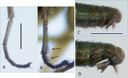
males can be recognized by the combination of an elongated, basally swollen first flagellomere with a narrow tip, plus rows of thickened setae located underneath the . These features distinguish Achradocera from the closely related Chrysotus, with which it was formerly confused. -level identification requires examination of male genitalia and other subtle morphological characters; a key to males is available in taxonomic revisions.
Images
Appearance
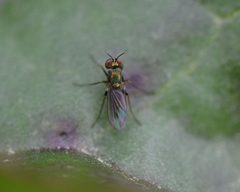
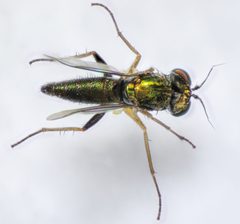
males possess distinctive secondary sexual characteristics: the first flagellomere of the is elongated, swollen at the base, and narrows toward the tip. Males also exhibit rows of thickened setae beneath the . The belongs to the long-legged fly and shares the generally slender body form typical of Dolichopodidae.
Distribution
Nearctic and , plus Polynesia. The barbata group occurs in the Nearctic region (eastern Canada, eastern USA, western USA). The femoralis group is primarily Neotropical (Mexico, Central America, Caribbean, and South America). Specific island distributions include Hawaii, French Polynesia, Marquesas, Tonga, and various Caribbean islands.
Similar Taxa
More Details
Taxonomic history
Restored as a separate by Harold E. Robinson in 1975 after being treated as a subgenus of Chrysotus. A major revision in 2024 described two new (A. balin, A. gimli), established three new synonyms, and revived one species status.
Biogeography
Geographically Explicit Event Model (GEM) analysis indicates vicariance as the primary driver of speciation, with founder events playing a secondary role in the 's diversification across the Americas.
Sources and further reading
- BugGuide
- Wikipedia
- GBIF taxonomy match
- iNaturalist taxon
- NCBI Taxonomy
- Catalogue of Life
- Taxonomic revision of Achradocera Becker (Diptera: Dolichopodidae), with description of two new species
- Vicariance drove the speciation in the Pan-American genus Achradocera Becker (Diptera: Dolichopodidae): insights from Geographically Explicit Event Model analysis