
Brachystomatidae
Melander, 1908
Genus Guides
3Brachystomatidae is a of predatory flies in the superfamily Empidoidea. The family comprises approximately 30 distributed across multiple , with greatest diversity in the Southern Hemisphere. Members are generally small to medium-sized flies associated with aquatic or semi-aquatic . The family has undergone significant taxonomic revision in recent decades, with numerous new and genera described from Chile, Australia, New Zealand, and southern South America.
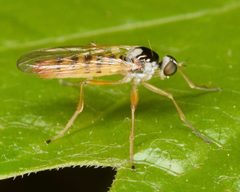
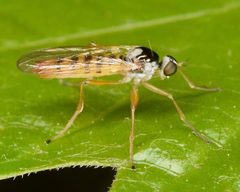
Pronunciation
How to pronounce Brachystomatidae: /bræˌkɪstoʊˈmætəˌdiː/
These audio files are automatically generated. While they are not always 100% accurate, they are a good starting point.
Images
Habitat
Many brachystomatid are associated with aquatic or semi-aquatic environments. The genus Gondwanodromia is explicitly described as "aquatic associated" and inhabits streams and riparian zones in southern South America, eastern Australia, and New Zealand. Some members of Trichopezinae occupy similar moist . Specific habitat preferences for many genera remain undocumented.
Distribution
The has a distribution with notable concentration in the Southern Hemisphere. Documented regional faunas include: Chile (36 in 5 ), Australia and New Zealand (multiple species of Gondwanodromia), Holarctic region (genus Gloma), Nearctic and Palearctic regions (genus Heleodromia), and Europe (genus Brachystoma). Distribution records also exist for Portugal, Morocco, and Wrangel Island (Chukotka, Russia).
Behavior
Field observations and videos have documented hunting and mating in Pseudheleodromia haenii. Possible oviposition behavior has been discussed for the Brachystoma in Europe, though this remains speculative. Most behavioral data for the is lacking.
Ecological Role
As members of Empidoidea, brachystomatids are presumed to function as in aquatic and riparian , though specific ecological roles have not been quantified. Their association with stream and riparian suggests importance in these .
Similar Taxa
- EmpididaeBoth belong to Empidoidea and share general predatory habits and body plans. Brachystomatidae is distinguished by specific wing venation characters and male terminalia structure; historically, the families have been subject to repeated reclassification of constituent .
- HybotidaeAnother empidoid with similar overall . Hybotidae generally exhibits different wing venation and leg structure; some formerly placed in Brachystomatidae have been transferred to Hybotidae based on phylogenetic analysis.
More Details
Taxonomic History
The has experienced substantial taxonomic instability. The 2022 description of Gondwanodromia established a new with 11 across three Southern Hemisphere landmasses, reflecting ongoing discovery. The genus Gloma was revised in 2019 with phylogenetic analysis suggesting possible relationship with Oreogeton. The Baltic amber genus Palaeoparamesia may be congeneric with Gloma. Several new combinations have been proposed, including Pseudheleodromia haenii comb. nov.
Subfamily Classification
The includes Brachystomatinae and Trichopezinae. The Trichopezinae contains such as Gloma, Heleodromia, Gondwanodromia, Boreodromia, Ceratempis, and Sematopoda. Generic limits and subfamily assignments remain active areas of research.
Sources and further reading
- BugGuide
- GBIF taxonomy match
- iNaturalist taxon
- NCBI Taxonomy
- Catalogue of Life
- A catalog of the Brachystomatidae of Chile (Diptera: Empidoidea)
- Revision of the Holarctic genus Gloma Meigen (Diptera: Empidoidea: Brachystomatidae: Trichopezinae)
- Revision of the Nearctic species ofHeleodromia(Diptera: Empidoidea: Brachystomatidae)
- Report on Brachystomatidae and Empididae (Hemerodromiinae, Clinocerinae) from continental Portugal and neighbouring countries
- A new aquatic associated genus of Trichopezinae from the Southern Hemisphere (Diptera: Empidoidea: Brachystomatidae)
- Review of three little-known monotypic empidoid genera (Diptera: Empidoidea: Brachystomatidae), assigned to Trichopezinae
- A review of the genus Brachystoma Meigen, 1822 in Europe (Diptera, Brachystomatidae) with a discussion of possible oviposition behaviour
- The Empidoid Flies (Diptera: Brachystomatidae, Empididae, Hybotidae) of Wrangel Island (Chukotka Autonomous Okrug): Composition and Distribution of the Fauna