
Uranotaenia sapphirina
(Osten Sacken, 1868)
Sapphire-striped Mosquito
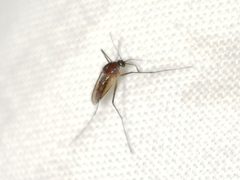
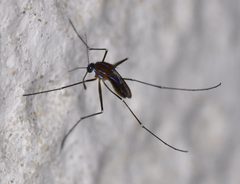
Uranotaenia sapphirina is a mosquito notable as the first documented mosquito specializing on non-vertebrate . Females feed primarily on annelids including earthworms and leeches rather than vertebrate blood, a feeding strategy unique among mosquitoes. The species occurs across eastern North America from Canada to Florida and west to Texas, with additional records in Mexico and the Caribbean. overwinter and larvae develop in semi-permanent and permanent wetlands with abundant vegetation.
Pronunciation
How to pronounce Uranotaenia sapphirina: //ˌʊrənoʊˈtiːniə səˈfaɪrɪnə//
These audio files are automatically generated. While they are not always 100% accurate, they are a good starting point.
Identification
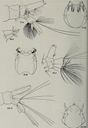
Larvae and females can be distinguished from the sympatric Uranotaenia socialis using morphological keys based on specific structural characters; an identification key is provided in Mexican faunal studies. Adults are small mosquitoes with characteristic features of the Uranotaenia. Accurate identification requires examination of genitalic structures in adults and specific larval setal arrangements.
Images
Habitat
Semi-permanent and permanent water bodies including swamps, marshes, and woodland pools with abundant vegetation. Larvae inhabit ground-level natural in conservation areas and wetland environments. Collections have been made in association with Anopheles albimanus, Culex erraticus, Mansonia titillans, and Uranotaenia lowii in aquatic habitats.
Distribution
Eastern North America from southern Canada (Ontario, Quebec, Manitoba, New Brunswick) through the United States to Florida and west to Texas. Mexican records from 18 states including Campeche, Chiapas, Colima, Guerrero, Hidalgo, Jalisco, Mexico City, Mexico State, Michoacán, Morelos, Oaxaca, Quintana Roo, Sinaloa, Tabasco, Tamaulipas, Veracruz, and Yucatán. Also recorded in Cuba. Recent detection in New Brunswick, Canada (2022-2024) suggests range expansion.
Seasonality
activity documented from May through October in north central Illinois. Overwinters as adults. Canadian collections span late May to late September, with peak activity in mid-summer to early autumn.
Diet
Females are of annelids (earthworms and leeches), with 100% of identified blood meals from annelids in Florida . In the northeastern United States, 47.6% of identified meals were solely annelid, with some individuals containing mixed annelid-avian bloodmeals and rare mammalian or avian meals alone. The mud earthworm Sparganophilus tennesseensis is the most common identified . of both sexes feed on sugar sources.
Host Associations
- Sparganophilus tennesseensis - primary blood Mud earthworm, most common in northeastern US
- annelids - primary blood feeding on earthworms and leeches
- leeches - blood Freshwater leeches documented as through field observations
- Turdus migratorius - occasional blood American robin, identified in mixed bloodmeals in northeastern US
Life Cycle
Overwinters as . Larvae develop in aquatic . Specific details of deposition, larval instars, and pupal duration not documented in available sources.
Behavior
Females exhibit specialized predatory targeting annelid , with field observations documenting feeding on Sparganophilus worms and freshwater leeches. Sugar-feeding behavior documented in Florida . Readily collected using CDC miniature CO2 light traps, peat fiber resting boxes, gravid traps, and backpack .
Ecological Role
of annelids in wetland . for viral including and Cypovirus (Reoviridae). Virus detected in specimens includes Eastern equine encephalomyelitis virus and West Nile virus, though competence remains unclear; likely dead-end or bridge vector rather than primary vector.
Human Relevance
Not a significant of human due to specialized annelid-feeding . Detection in new regions (e.g., New Brunswick, Illinois) serves as for climate-driven range expansion and changing faunal diversity. Contributes to mosquito biodiversity assessments and ecological monitoring programs.
Similar Taxa
- Uranotaenia lowiiSympatric that feeds exclusively on anurans (frogs and toads) rather than annelids; distinguished by association and molecular/morphological characters
- Uranotaenia socialisSympatric in Mexico and southeastern US; distinguished by specific larval and female morphological characters detailed in identification keys
More Details
Viral Associations
Specimens have been found harboring and Cypovirus ( Reoviridae). Eastern equine encephalomyelitis virus and West Nile virus have been detected in specimens, but competence is unclear and the is not considered an epidemiologically significant vector.
Range Expansion
First detection in New Brunswick, Canada in 2022-2024 represents a northward range expansion from previously known Canadian distribution limited to Ontario, Quebec, and Manitoba. First record in Lee County, Illinois in 2018-2019 also indicates ongoing range dynamics.
Sources and further reading
- BugGuide
- Wikipedia
- GBIF taxonomy match
- iNaturalist taxon
- NCBI Taxonomy
- Uranotaenia sapphirina Osten Sacken (Insecta: Diptera: Culicidae: Culicinae)
- The Distribution of Uranotaenia sapphirina and Ur. socialis in Tabasco, Southern Mexico
- First detection of mosquito Uranotaenia sapphirina (Diptera: Culicidae) in New Brunswick, Canada
- A New Record of Uranotaenia sapphirina and Aedes japonicus in Lee and Ogle Counties, Illinois
- Identification of Uranotaenia sapphirina as a specialist of annelids broadens known mosquito host use patterns
- Evidence of Uranotaenia sapphirina (Diptera: Culicidae) feeding on annelid worms in the Northeastern United States