
Culex territans
Walker, 1856
Northern Frog-biting Mosquito
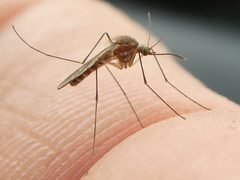
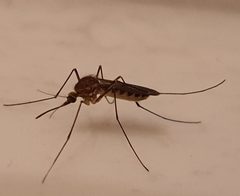
Culex territans, commonly known as the Northern Frog-biting Mosquito, is a mosquito with a nearly exclusive feeding relationship with amphibians, particularly frogs. females are strongly attracted to frog vocalizations and exhibit temporal and spatial synchrony with their amphibian . The species is a confirmed for multiple amphibian , including Giant Anuran , Hepatozoon species, and potentially Batrachochytrium dendrobatidis. Unlike many Culex species, it poses minimal direct threat to human health due to its host preferences, though it has been found infected with West Nile Virus and virus.
Pronunciation
How to pronounce Culex territans: /ˈkjuː.lɛks ˈtɛr.ɪ.tænz/
These audio files are automatically generated. While they are not always 100% accurate, they are a good starting point.
Identification
Culex territans can be distinguished from other Culex by its -seeking : it is strongly attracted to frog calls rather than mammalian cues, and requires light for host-seeking activity. Unlike Culex pipiens and related species that form dense in human-made containers, Cx. territans is found in association with natural wetlands and amphibian breeding . Body temperature is not an important cue in host-seeking, consistent with its ectothermic hosts. Morphological identification requires examination of genitalia or other taxonomic characters typical of the Culex (Neoculex) subgenus.
Images
Habitat
Larval include clean freshwater ponds with abundant vegetation, pools, and artificial containers such as tires. overwinter in protected, humid, underground environments including caves. In northern Europe, females have been documented in caves alongside Culex pipiens, Culex torrentium, and Culiseta annulata. The is associated with wetlands and agricultural wetlands in coastal plain regions.
Distribution
Widespread across North America north of Mexico, Europe, North Africa, and the Arabian Peninsula. Documented in specific locations including Florida, Georgia, North Carolina, West Virginia, New Jersey, Virginia, Ontario (Canada), and Sweden.
Seasonality
females overwinter in in protected underground environments. Activity patterns are synchronized with amphibian availability, with temporal activity matching frog breeding seasons. In temperate regions, adults emerge from sites when conditions permit and amphibian hosts become active.
Diet
females are , feeding primarily on ectothermic vertebrates with a strong preference for amphibians, especially frogs (Rana clamitans and Rana catesbeiana). Blood meal analysis confirms green frogs and bullfrogs as primary . Rare opportunistic feeding on birds of prey has been observed at raptor centers. Males feed on nectar and other sources.
Host Associations
- Rana clamitans (green frog) - primary blood Confirmed by blood meal analysis; temporal and spatial synchrony documented
- Rana catesbeiana (bullfrog) - primary blood Confirmed by blood meal analysis; experimental transmission studies conducted
- Amphibians (general) - Near-exclusive feeding association with ectothermic vertebrates
Life Cycle
Complete with , larval, pupal, and stages. Eggs are laid on water surface. Larval development occurs in aquatic . Adult females enter for . Specific reproductive timing is tied to amphibian presence and vocalizations.
Behavior
Exhibits phonotaxis—strong attraction to amphibian vocalizations for location. Requires light for host-seeking activity; does not feed in complete darkness. Body temperature is not used as a host-seeking cue, unlike mammal-feeding mosquitoes. Shows temporal and spatial synchrony with amphibian hosts, adjusting activity patterns to match host availability. Females have been observed taking blood meals lasting extended periods due to the small size of amphibian capillaries.
Ecological Role
Confirmed for Giant Anuran (GATs), with trypanosomes detected in 2 days post-feeding and in body/saliva 14 days post-feeding. Vector for Hepatozoon catesbianae and Hepatozoon clamatae. Vector for Foleyella flexicauda. Demonstrated mechanical transmission capability for Batrachochytrium dendrobatidis spores between frogs. Implicated in transmission of frog erythrocytic virus. Contributes to transmission cycles in amphibian and may influence dynamics in declining amphibian populations.
Human Relevance
Minimal direct threat to human health due to specialized amphibian-feeding . However, has been found naturally infected with West Nile Virus and virus, and may occasionally feed on humans, creating potential for incidental transmission. Serves as a research model for understanding mosquito- , phonotaxis, and in non-human systems.
Similar Taxa
- Culex pipiensOverlaps in geographic range and larval use; distinguished by preferences (Cx. pipiens feeds primarily on birds and mammals), (Cx. pipiens often in above-ground structures), and lack of phonotaxis to amphibian calls
- Culex quinquefasciatusSimilar and larval ; distinguished by preferences (Cx. quinquefasciatus feeds on mammals and birds), geographic distribution (more southern), and association with urban/peridomestic environments
- Culex torrentiumOverlaps in European range and cave sites; distinguished by preferences and lack of documented amphibian specialization
More Details
Research Significance
Culex territans serves as an important model for studying the evolution of specialization in mosquitoes, as it represents a derived shift from the typical mammal/bird feeding pattern of the Culex to nearly exclusive amphibian feeding. Its phonotactic provides a tractable system for studying sensory and neural processing of acoustic cues in mosquitoes.
Pathogen Interactions
Despite feeding primarily on non-mammalian , Cx. territans has been documented carrying human including West Nile Virus and virus, likely acquired through or incidental feeding. The has also been shown capable of mechanically transmitting chytrid fungus spores between frogs, potentially contributing to amphibian dynamics.
Sources and further reading
- BugGuide
- Wikipedia
- GBIF taxonomy match
- iNaturalist taxon
- NCBI Taxonomy
- Catalogue of Life
- Are Culex Mosquitoes Potential Vectors of the Zika Virus? | Bug Squad
- Breaking News: Zika Virus Found in Wild-Caught Culex | Bug Squad
- Megan Meuti's Way of Tricking Mosquitoes Into Not Biting You | Bug Squad
- Unique Egg-Laying Behavior Re-Discovered in Culex Mosquito Species
- Bloodsuckers in the basement: Subterranean mosquito, Culex pipiens form molestus — Bug of the Week
- There will be blood: Northern House Mosquito, Culex pipiens, and friends — Bug of the Week
- Culex territans mosquitoes as a vector of Giant Anuran Trypanosomes
- Northern frog biting mosquito Culex territans (Walker 1856) (Insecta: Diptera: Culicidae)
- Temporal and Spatial Synchrony of Culex territans (Diptera: Culicidae) with Their Amphibian Hosts
- Influence of Hepatozoon parasites on host-seeking and host-choice behaviour of the mosquitoes Culex territans and Culex pipiens
- The role of Culex territans mosquitoes in the transmission of Batrachochytrium dendrobatidis to amphibian hosts
- Vertebrate Hosts and Phylogenetic Relationships of Amphibian Trypanosomes from a Potential Invertebrate Vector, Culex territans Walker (Diptera: Culicidae)
- Temporal and Spatial Synchrony of <I>Culex territans</I> (Diptera: Culicidae) with Their Amphibian Hosts
- The Life History, Ultrastructure, and Experimental Transmission of Hepatozoon catesbianae n. comb., an Apicomplexan Parasite of the Bullfrog, Rana catesbeiana and the Mosquito, Culex territans in Algonquin Park, Ontario