
Anopheles pseudopunctipennis
Theobald, 1901
Anopheles pseudopunctipennis is a neotropical mosquito and major in Latin America, transmitting Plasmodium vivax and other malaria-causing protozoans to humans. It is widely distributed from the southern United States to northern Argentina, with particular abundance in foothills and valleys of mountainous regions and arid environments. The species is strongly associated with sunlit freshwater pools containing filamentous green , which serve as primary larval . It exhibits dry season activity patterns, becoming most abundant when other vector species decline.
Identification
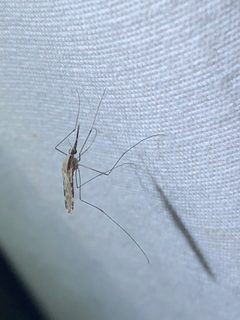
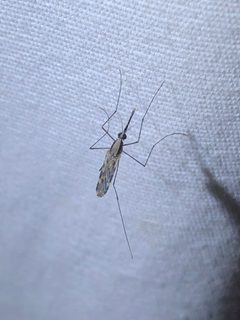
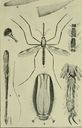
Larvae are identified by a unique spiracular apparatus; display characteristic black hind tarsomeres and an unspotted wing . Larvae possess -lateral caudal filaments that show continuous phenotypic variation in length within , with some individuals displaying unusually long filaments.
Images
Habitat
Larvae develop in sunlit freshwater pools, typically clear and shallow with abundant filamentous green (including Rhizoclonium). Breeding sites are commonly located in dry, arid valleys or foothills of mountainous regions. include natural pools and artificial containers such as cement-bottomed ponds.
Distribution
Widely distributed across the Americas from the southern United States through Mexico, Central America, and South America to northern Argentina and Chile. Present in the Andes, the Lesser Antilles, and river ravines of northern Chile (Arica and Tarapacá regions). Documented in Ecuador, Bolivia, and confirmed in Cochabamba, Bolivia after 90 years of suspected presence.
Seasonality
Most active during the dry season, when breeding sites become more common and the assumes greater importance in transmission as other species decline.
Life Cycle
are laid in aquatic . Larvae develop through four instars in sunlit freshwater pools with filamentous . occurs in the same aquatic environment. Laboratory rearing from larval collection to has been demonstrated.
Behavior
Females exhibit -seeking approaching houses. Larval has not been documented for this specifically, but related Anopheles species show cannibalistic behaviors. The species is notably difficult to maintain under laboratory conditions, limiting detailed behavioral study.
Ecological Role
Major of in Latin America, particularly important in dry season transmission when other vector are less active. Transmits Plasmodium vivax (both VK210 and VK247 phenotypes) and contributes to malaria in Mexico, where it is more susceptible to VK247 phenotype than coastal vector species.
Human Relevance
Significant public health importance as a primary in Central and South America. Control efforts target larval through reduction, which significantly lowers larval densities and . Susceptible to including novaluron, which inhibits adult . Subject to repellent screening assays using DEET and plant .
Similar Taxa
- Anopheles albimanusCoastal in Latin America; more susceptible to Plasmodium vivax VK210 phenotype whereas An. pseudopunctipennis is more susceptible to VK247; occupies different altitudinal zones with An. albimanus at lower elevations
- Anopheles punctipennisNorth American Anopheles with woodland preference; not a major in the same geographic region
- Anopheles quadrimaculatusHistorical in the United States with different distribution and preferences; peaks in late summer with different
Sources and further reading
- BugGuide
- Wikipedia
- GBIF taxonomy match
- iNaturalist taxon
- NCBI Taxonomy
- Catalogue of Life
- Anthony Cornel Knows Mosquitoes | Bug Squad
- Anopheles Mosquitoes as Vectors of Malaria in East Africa: Bed Nets and Beyond
- How One State's Mosquito Data Could Reduce Risk of Malaria Returning to U.S.
- Cannibalism in Mosquito Larvae Confounds Egg Counts
- The Sweetest Snack: Research Details Mosquitoes' Nectar Preferences
- Inducing Mosquitoes to Lay Eggs Aids in Insecticide Resistance Testing
- Characterization of larval habitats of Anopheles albimanus, Anopheles pseudopunctipennis, Anopheles punctimacula, and Anopheles oswaldoi s.l. populations in lowland and highland Ecuador
- Detection of Anopheles pseudopunctipennis (Diptera: Culicidae) in Cochabamba, Bolivia, after 90 years of suspected presence
- A sanitary safe method for screening mosquito repellents on Anopheles pseudopunctipennis and Aedes aegypti
- Statistical analysis of larval postspiracular filament length reveals continuous variation in Bolivian Anopheles pseudopunctipennis (Diptera: Culicidae)
- Host choice and human blood index of Anopheles pseudopunctipennis in a village of the Andean valleys of Bolivia
- A Video-Tracking Analysis-Based Behavioral Assay for Larvae of Anopheles pseudopunctipennis and Aedes aegypti (Diptera: Culicidae)
- Effect of Novaluron (Rimon ® 10 EC) on the mosquitoes Anopheles albimanus, Anopheles pseudopunctipennis, Aedes aegypti, Aedes albopictus and Culex quinquefasciatus from Chiapas, Mexico
- Different prevalences of Plasmodium vivax phenotypes VK210 and VK247 associated with the distribution of Anopheles albimanus and Anopheles pseudopunctipennis in Mexico.
- Modeling the Potential Distribution of the Malaria Vector Anopheles (Ano.) pseudopunctipennis Theobald (Diptera: Culicidae) in Arid Regions of Northern Chile