
Anopheles crucians
Wiedemann, 1828
Anopheles crucians is a mosquito inhabiting shaded aquatic environments with acidic water, particularly cypress swamps. It breeds in semipermanent and permanent pools, ponds, lakes, and swamps. The species is a documented for parasitic water mites (Arrenurus spp.), with males showing significantly higher rates due to surface water contact during swarming . It has been implicated as a potential , with historical research documenting Plasmodium falciparum in 75% of examined individuals.
Pronunciation
How to pronounce Anopheles crucians: /əˈnɒfɪliːz ˈkruːʃiænz/
These audio files are automatically generated. While they are not always 100% accurate, they are a good starting point.
Identification
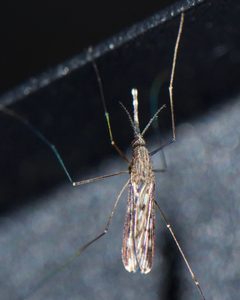
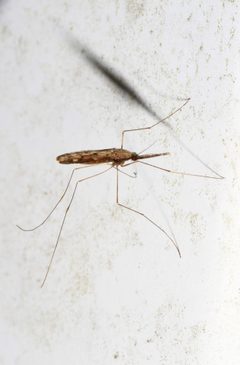
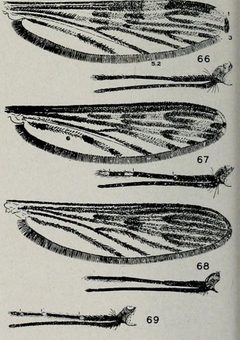
Distinguished from similar Anopheles by the six-segmented with specific color pattern: black basal segment with raised , white scales on segment 3, white rings on segment 4, and white terminal segment. Very similar in anatomy to Anopheles bradleyi; separation requires examination of pedipalp segmentation and scaling patterns. Wing markings and leg patterning provide additional diagnostic characters.
Images
Habitat
Shaded aquatic environments with acidic water, particularly cypress swamps. Breeds in semipermanent and permanent pools, ponds, lakes, and swamps. In salt marsh environments, shows preference for grassy areas over open water or mangrove .
Distribution
North America, Middle America, and Caribbean. Documented in Florida salt marshes, northern Belize, and Iowa (where it was among less abundant Anopheles in 20-year sampling study).
Seasonality
Active during warmer months. In Florida, parasitic mite peak in May and September, corresponding with activity. In Iowa, emerges during summer with abundance patterns typical of permanent-water breeding Anopheles .
Host Associations
- Arrenurus pseudotenuicollis - Water mite that reduces survival and of
- Arrenurus spp. - Mites attach primarily to second abdominal segment; show male-biased selection with up to 100% in some male
Life Cycle
Aquatic larval and pupal stages in permanent and semipermanent water bodies. emerge and engage in swarming over surface waters, during which males experience increased exposure to parasitic mite larvae. Mites have aquatic larval stages that parasitize adult mosquitoes.
Behavior
Males engage in swarming over surface waters, which increases their exposure to aquatic mite larvae and explains observed male-biased . Females blood-feed on vertebrate (specific hosts not documented in available sources).
Ecological Role
for parasitic water mites (Arrenurus spp.); potential for Plasmodium falciparum. Part of in cypress swamp and acidic water as both (larval filter-feeding) and prey.
Human Relevance
Potential ; 1916 research found 75% of examined individuals infected with Plasmodium falciparum oocysts, sporozoites, or both. Subject of public health surveillance in regions where malaria transmission risk is assessed. for parasitic mites studied for potential.
Similar Taxa
- Anopheles bradleyiExtremely similar anatomy; distinguished by segmentation and scaling patterns
- Anopheles quadrimaculatusShares permanent water breeding and geographic range; distinguished by wing spot patterns and abdominal scaling
More Details
Taxonomic note
Anopheles crucians sensu lato represents a ; some sources treat A. crucians bradleri as a distinct with specific preferences in salt marshes.
Malaria vector status
While historically implicated as a based on Plasmodium rates, contemporary assessments of vector competence and epidemiological significance appear limited in published literature.
Sources and further reading
- BugGuide
- Wikipedia
- GBIF taxonomy match
- iNaturalist taxon
- NCBI Taxonomy
- Catalogue of Life
- Anthony Cornel Knows Mosquitoes | Bug Squad
- How One State's Mosquito Data Could Reduce Risk of Malaria Returning to U.S.
- Anopheles Mosquitoes as Vectors of Malaria in East Africa: Bed Nets and Beyond
- Cannibalism in Mosquito Larvae Confounds Egg Counts
- The Sweetest Snack: Research Details Mosquitoes' Nectar Preferences
- Inducing Mosquitoes to Lay Eggs Aids in Insecticide Resistance Testing
- Distribution of Anopheles albimanus, Anopheles vestitipennis, and Anopheles crucians Associated with Land Use in Northern Belize
- Salinity Tolerance of Anopheles quadrimaculatus and Habitat Preference of A. crucians bradleri
- Sexual Bias in Host Selection by Parasitic Mites of the Mosquito Anopheles crucians (Diptera: Culicidae)
- The Effect of a Parasitic Water Mite, Arrenurus Pseudotenuicollis1 (Acari: Hydrachnellae), on the Survival and Reproduction of the Mosquito Anopheles Crucians (Diptera: Culicidae)
- Distribution of <I>Anopheles albimanus</I>, <I>Anopheles vestitipennis</I>, and <I>Anopheles crucians</I> Associated with Land Use in Northern Belize
- Identification, seasonality, and body attachment location and nomenclature of parasitic water mites (Trombidiformes: Arrenuridae) on Anopheles crucians sensu lato, Anopheles quadrimaculatus sensu lato, and Culex erraticus (Diptera: Culicidae) from a North Florida botanical garden