
Diamesa
Meigen, 1835
Winter Midges, Snow Midges
Species Guides
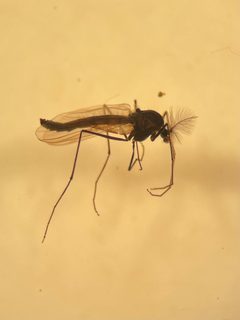
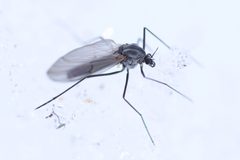
1- Diamesa nivoriunda(winter midge)
Diamesa is a of non-biting midges in the Diamesinae of the Chironomidae. are commonly known as winter or snow midges due to their unusual cold-season activity. The genus exhibits remarkable cold , with adults active at sub-zero temperatures and larvae inhabiting cold, running waters. Some display wing dimorphism, with brachypterous (short-winged) forms adapted for ground mating on snow and ice, and (fully-winged) forms that swarm in during spring.
Pronunciation
How to pronounce Diamesa: /daɪˈæmɪsə/
These audio files are automatically generated. While they are not always 100% accurate, they are a good starting point.
Identification
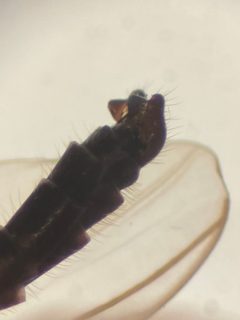
Diamesa are small, delicate flies resembling mosquitoes superficially but lacking piercing mouthparts. Males typically have (feathery) , a characteristic of the Chironomidae. Wing dimorphism occurs in some species: brachypterous forms have reduced wings with simplified venation and cannot fly, while forms possess fully developed wings. Accurate identification to species level requires examination of male genitalia and often .
Images
Habitat
Cold, running freshwater environments including streams, springs, and groundwater-fed watercourses. Associated with glacial streams, snowmelt-fed waters, and other cold-water in mountainous and arctic regions. of brachypterous forms are found on snow and ice surrounding stream banks.
Distribution
Holarctic distribution with records from Europe (Alps, Carpathians, Scandinavia), Asia (Himalayas, Pamir, Tian-Shan, Tibet, Nepal, Siberia), and North America. occur at high elevations, with some recorded above 5,000 m in the Himalayas and 2,600+ m in alpine regions.
Seasonality
activity primarily during winter months. Brachypterous forms emerge in December through February, active at air temperatures from -3°C to +1°C. forms swarm in spring (April). Some demonstrate continuous -laying throughout the year with multiple .
Diet
Larvae feed on organic debris in cold, running water. do not feed; they lack functional mouthparts or suitable food sources are unavailable during their winter activity period.
Life Cycle
Holometabolous development with , larva, pupa, and stages. Larvae are aquatic, inhabiting cold running waters. occurs in the same . Some are multivoltine, producing 8-10 per year depending on water temperature. Development is rapid despite cold conditions: Diamesa incallida completes development at water temperatures of 7.6-8.0°C.
Behavior
Brachypterous walk on snow and ice, capable of covering considerable distances. They mate on the ground at sub-zero temperatures (-3°C). adults swarm in near snow-bound stream banks. Adults can survive burial under snow for extended periods (at least 28 days documented). Some show attraction to .
Ecological Role
Important component of cold-water stream . Larvae contribute to decomposition of organic matter. High productivity in crenal (spring-) communities due to rapid multivoltine . Serve as food source for aquatic and terrestrial in cold environments where few other insects are active.
Human Relevance
Used as bioindicators for cold-water health and water quality monitoring. Sensitive to pollutants including pharmaceuticals, , and treated sewage effluents, though generally more than other model due to cold-adapted physiology. D. magna has been evaluated as a surrogate for D. cinerella in biomonitoring protocols for alpine sewage treatment plants.
Similar Taxa
- ChironomusBoth are , but Chironomus are typically larger, have different larval (often lentic), and are active in warmer seasons. Diamesa is distinguished by cold-stenothermy and winter activity.
- Belgica antarcticaBoth are cold-adapted chironomids with brachypterous forms, but B. antarctica is restricted to Antarctica and has even more reduced wings; Diamesa show greater mobility on snow.
- Tipulidae (crane flies)Superficially similar delicate flies, but crane flies have extremely long legs, distinct wing venation with a , and different structure. of many crane fly also do not feed.
More Details
Wing Dimorphism
Some Diamesa exhibit two distinct morphs: brachypterous (short-winged) forms that emerge in winter for ground mating, and (fully-winged) forms that swarm in spring. This dimorphism represents an to cold conditions where is energetically costly or impossible.
Cold Tolerance Mechanisms
Genomic studies of four Diamesa have revealed genetic adaptations for cold and high-altitude survival. The demonstrates extreme cold-stenothermy, with activity and occurring at temperatures lethal to most other insects.
Taxonomic Complexity
The requires integrative combining morphological examination (particularly of male genitalia) with using COI sequences. Several groups (steinboecki group, etc.) have been revised using molecular data. Cryptic diversity is likely given the morphological conservatism and broad geographic ranges.
Sources and further reading
- BugGuide
- Wikipedia
- GBIF taxonomy match
- iNaturalist taxon
- NCBI Taxonomy
- Catalogue of Life
- Chironomidae | Beetles In The Bush
- Lauraceae | Beetles In The Bush
- Missouri | Beetles In The Bush | Page 2
- The peculiar winter-active midge Diamesa starmachi (Diptera: Chironomidae)
- Fast life in cold water: Diamesa incallida (Chironomidae)
- Diamesa amanoi sp. n., a new species of Diamesinae (Diptera, Chironomidae) from Nepal, with notes on taxonomy and distribution of some Diamesa Meigen
- Survivorship and longevity of Diamesa mendotae Muttkowski (Diptera: Chironomidae) under snow
- On the taxonomy and distribution of Diamesa insignipes Kieffer (Diptera: Chironomidae: Diamesinae)
- New species of Diamesa (Diptera: Chironomidae) from Tibet: conspecific males and females associated with mitochondrial DNA
- The species of the genus Diamesa (Diptera, Chironomidae) known to occur in Italian Alps and Apennines
- Response of Diamesa spp. (Diptera: Chironomidae) from Alpine streams to newly emergent contaminants and pesticides
- Redescription of the Caucasian endemic Diamesa caucasica Kownacki et Kownacka (Diptera: Chironomidae: Diamesinae)
- Morphological redescription and DNA barcoding of Diamesa longipes Goetghebuer, 1941 (Diptera: Chironomidae: Diamesinae) from the Swiss Alps
- Diamesa mendotae (Diptera: Chironomidae) Demonstrate Predictable Behavior Patterns Associated with Aging and Mortality
- On the taxonomy and distribution of Diamesa gregsoni Edwards, (Diptera: Chironomidae: Diamesinae), with morphological redescription and DNA barcoding of species from the Far East
- Effects of a treated sewage effluent on behavioural traits in Diamesa cinerella and Daphnia magna
- Taxonomy of Diamesa steinboecki group (Diptera: Chironomidae: Diamesinae), with description and DNA barcoding of new species. I. Subgroups steinboecki and longipes
- Comparison of the behavioural effects of pharmaceuticals and pesticides on Diamesa zernyi larvae (Chironomidae)
- Haplotype-resolved chromosome-level genome assemblies of four Diamesa species reveal the genetic basis of cold tolerance and high-altitude adaptations in arctic chironomids.