
Chironomus crassicaudatus
Malloch, 1915
thick-tailed non-biting midge, thick-skinned midge
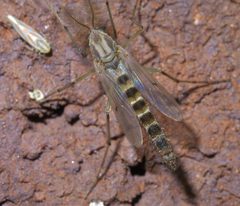
Chironomus crassicaudatus is a non-biting midge in the Chironomidae, described by Malloch in 1915. The is known from the eastern United States, ranging from Texas to New York. It has been documented in a rare case of human urogenital myiasis in Kolkata, India, where larvae were found in the urine of a patient living in unhygienic conditions with shared toilet facilities. As a member of the non-biting midges, lack functional mouthparts and do not feed on blood.
Pronunciation
How to pronounce Chironomus crassicaudatus: /kɪˈrɒnəməs ˌkræsɪˌkɔːˈdeɪtəs/
These audio files are automatically generated. While they are not always 100% accurate, they are a good starting point.
Identification
Larvae can be identified by morphological features including: frontoclypeal apotome present; medial labral distinct; pecten epipharyngis with comb-like multi-toothed structure; bifid pre-; paired tubules on the eleventh body segment; with trifid tooth and six lateral teeth; mandibles bearing three inner teeth. These features distinguish it from other Chironomus and from myiasis-causing Calliphoridae.
Images
Habitat
Breeds in and around human dwellings, particularly on soiled moist surfaces and low-lying water bodies. Can thrive across a wide range of environmental conditions, oxygen concentrations, and vegetation types. Semi-aquatic support larval development.
Distribution
Eastern United States from Texas to New York. Documented in Kolkata, India in association with human habitation and poor sanitary conditions.
Diet
Larvae feed on organic debris in aquatic and semi-aquatic environments. In cases of accidental human , larvae have been observed feeding on and commensals in the urogenital tract.
Host Associations
- Homo sapiens - accidental urogenital myiasisDocumented in one case from Kolkata, India; not a natural
Life Cycle
deposited on soiled surfaces and toilets. Larvae emerge and typically develop as free-living organisms feeding on organic debris. When becomes high or breeding becomes scarce, larvae may invade wounds and natural openings of humans or animals. Larvae are capable of anhydrobiosis, surviving in dry states. In accidental , larvae continue development feeding on host and are expelled in urine during .
Behavior
do not bite and lack functional mouthparts for blood feeding. Practice anhydrobiosis as larvae, allowing survival under desiccating conditions. When breeding become overcrowded or degraded, larvae demonstrate facultative parasitic by invading natural openings of vertebrate attracted by putrefying odors.
Ecological Role
Decomposer in aquatic and semi-aquatic through larval feeding on organic debris. Serves as a public health concern as a of accidental myiasis in tropical countries with poor infrastructure.
Human Relevance
Documented as a cause of rare human urogenital myiasis in unhygienic conditions. The 2014 case from Kolkata, India represents the first recorded instance of this causing human myiasis. is preventable through improved , elimination of fly breeding near dwellings, and avoiding shared toilet facilities. Successfully treated with albendazole (400 mg weekly for four weeks).
Similar Taxa
- Chironomus spp.Other in share general ; C. crassicaudatus distinguished by specific larval mouthpart structures including trifid tooth with six lateral teeth and with three inner teeth
- CalliphoridaePrimary myiasis-causing flies; C. crassicaudatus is a non-myiasis-producing fly that only causes accidental/facultative myiasis under unusual conditions of high and poor
- Culex spp.Biting mosquitoes with superficial resemblance; distinguished by lack of piercing mouthparts in Chironomidae, and by in male chironomids
More Details
Taxonomic status
Catalogue of Life lists this as a synonym, though GBIF and NCBI recognize it as accepted. The taxonomic status may require verification.
Myiasis classification
The human documented in Kolkata represents pseudomyiasis or facultative myiasis—larvae are not obligate but free-living organisms that invade opportunistically when environmental conditions deteriorate. This distinguishes C. crassicaudatus from obligatory myiasis-causing flies such as Oestrus ovis or .
Sources and further reading
- BugGuide
- Wikipedia
- GBIF taxonomy match
- iNaturalist taxon
- NCBI Taxonomy
- Catalogue of Life
- biodiversity | Blog - Part 35
- Uncategorized | Blog - Part 13
- Hollywood is for the Bugs
- A Rare Case of Human Urogenital Myiasis Caused by Chironomus crassicaudatus (Diptera: Chironomidae) from Kolkata, India
- A Rare Case of Human Urogenital Myiasis Caused by Chironomus crassicaudatus (Diptera: Chironomidae) from Kolkata, India