
Meromyza americana
Fitch, 1856
Wheat Stem Maggot
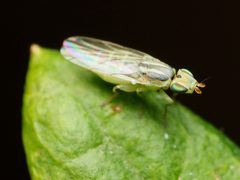
Meromyza americana, commonly known as the Wheat Stem Maggot, is a chloropid fly whose larvae are significant pests of small grain cereals. The species completes a second in spring, with emerging to lay on barley, oats, rye, wheat, and other grass . Larval feeding occurs within stems, causing characteristic whitehead in infested tillers. Despite its pest status, rarely exceed 1% of tillers, making treatments generally unnecessary.
Pronunciation
How to pronounce Meromyza americana: /mɛrəˈmaɪzə əˌmɛrɪˈkeɪnə/
These audio files are automatically generated. While they are not always 100% accurate, they are a good starting point.
Identification
Larval damage produces distinctive whiteheads: grain turn from green to tan to white while leaf and stems below the feeding site remain green. These whiteheads are easily pulled from the plant. The maggots feed just above the last stem joint, cutting moisture and nutrient flow to the head. are small flies in the Chloropidae; specific diagnostic features for field identification are not well documented in available sources.
Images
Habitat
Agricultural and natural grassland supporting small grain cereals and related grasses. Documented include barley, oats, rye, wheat, and intermediate wheatgrass (Thinopyrum intermedium).
Distribution
North America. Documented occurrence in Oklahoma and inferred distribution in regions where small grain cereals are cultivated.
Seasonality
of the second emerge in spring. laying occurs on young cereal plants during this period. Larval development proceeds through spring and early summer.
Diet
Larvae feed internally on cereal stems, consuming vascular tissue at the node just above the last stem joint. This feeding severs the flow of moisture and nutrients to the developing grain .
Host Associations
- Hordeum vulgare - larval barley
- Avena sativa - larval oats
- Secale cereale - larval rye
- Triticum aestivum - larval wheat
- Thinopyrum intermedium - larval intermediate wheatgrass; documented in Oklahoma
Life Cycle
Second- emerge in spring and deposit on leaves of grasses. Larvae, or maggots, tunnel into stems and feed at the node above the last stem joint. After completing development, larvae presumably pupate in soil or plant debris, though pupal details are not explicitly documented. The appears to have at least two generations annually based on the designation of a 'second generation' in spring.
Behavior
females lay on leaf surfaces of cereals. Larvae exhibit stem-boring , tunneling to feed at a specific nodal location that maximizes disruption of nutrient transport to the grain . This precise feeding location produces the characteristic whitehead .
Ecological Role
A minor pest of cereal agriculture. levels typically remain below . Infested tillers are effectively removed from production, but overall crop impact is limited by low rates.
Human Relevance
Agricultural pest of small grain cereals including wheat, barley, oats, and rye. Economic impact is generally minimal; rarely exceed 1% of tillers, and treatments are rarely if ever necessary. The has been documented in intermediate wheatgrass, a grain crop under development.
Similar Taxa
- Other ChloropidaeMany chloropid flies are grass stem borers; specific identification requires examination of morphological characters not detailed in available sources.
- Wheat stem sawfly (Cephus cinctus)Also causes whiteheads in wheat, but is a hymenopteran with different larval and feeding location; larvae feed in the lower stem and leave sawdust-like .
More Details
Pest Management
are rarely reached. Treatment is generally not recommended even when whiteheads are observed, as infested tillers typically represent less than 1% of the crop.
Perennial Grain Concern
Documentation in intermediate wheatgrass (Thinopyrum intermedium) in Oklahoma suggests potential relevance for emerging grain agriculture systems.
Sources and further reading
- BugGuide
- Wikipedia
- GBIF taxonomy match
- iNaturalist taxon
- NCBI Taxonomy
- Catalogue of Life
- Occasional Pests - AgriLife Extension Entomology
- Deerly departed: food for flesh-recycling carrion beetles - Margined carrion beetle, Oiceoptoma noveboracense, and American carrion beetle, Necrophila americana — Bug of the Week
- Unwelcome guests in Hawai’i: American cockroach, Periplaneta americana, German cockroach, Blattella germanica, and Western yellowjacket, Vespula pensylvanica — Bug of the Week
- As a Watershed is Urbanized, Damselflies Show Declines
- Silphidae | Beetles In The Bush
- Explorer or Wallflower? Study Shines Light on Cockroach Personalities
- Occurrence of the Wheat Stem Maggot, Meromyza americana Fitch (Diptera: Chloropidae), in Intermediate Wheatgrass, Thinopyrum intermedium (Host) Barkworth and D. R. Dewey (Poaceae), in Oklahoma1