
Rhopalomyia lobata
Felt, 1908
Rhopalomyia lobata is a gall midge ( Cecidomyiidae) that induces large, multi-chambered galls on the stems and buds of Euthamia graminifolia (grass-leaved goldenrod). The has a broad North American distribution spanning from Florida to Oregon and northward across Canada. occurs during late June to mid-July, after which the galls desiccate and persist on plants for several weeks.
Pronunciation
How to pronounce Rhopalomyia lobata: /roʊˌfæloʊˈmɪiə loʊˈbeɪtə/
These audio files are automatically generated. While they are not always 100% accurate, they are a good starting point.
Identification
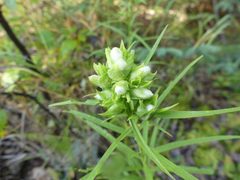
Galls are distinguished by their large size (up to 6 cm diameter), spongy texture, and multiple larval chambers (5–35) embedded within whitish tissue. Galls form at and lateral buds, sometimes in clusters near shoot tips. Leaves surrounding the gall are wider than typical foliage. After in late June to mid-July, galls turn black and dry.
Images
Habitat
Associated with stands of Euthamia graminifolia (grass-leaved goldenrod), occurring in open, sunny where this plant grows.
Distribution
Eastern and central North America: from Florida to Mississippi, north to New England, and west to Oregon. Range extends across most of Canada.
Seasonality
occurs from late June to mid-July. Galls become visible earlier in spring, with leaves loosening from the gall structure by the second week of June.
Diet
Larvae feed on plant tissue within induced galls on Euthamia graminifolia. feeding habits are not documented.
Host Associations
- Euthamia graminifolia - induces galls on stems and budsgrass-leaved goldenrod; sole documented
Life Cycle
are deposited in bud tissue, inducing gall formation. Larvae develop within separate chambers inside the spongy gall mass. occurs within chambers. emerge from late June to mid-July, leaving exposed fleshy core. Galls subsequently turn black and persist in dried condition.
Ecological Role
As a gall inducer, modifies plant growth and architecture. Provides enclosed microhabitat for larval development. Specific interactions with or are not documented.
Similar Taxa
- Other Rhopalomyia speciesMany induce galls on goldenrods (Solidago and related ); R. lobata is distinguished by specificity on Euthamia graminifolia and gall (large, multi-chambered, up to 6 cm with 5–35 chambers)
- Asphondylia speciesSome induce stem galls on goldenrods; differ in gall structure, typically smaller and with fewer chambers