
Dasineura gleditchiae
(Osten Sacken, 1866)
honeylocust podgall midge, Gleditsia Gall Midge
Dasineura gleditchiae is a gall midge in the Cecidomyiidae that induces pod-like galls on honey locust (Gleditsia triacanthos). Native to North America, it has become established as an in parts of Europe, where it was first recorded in the late 20th century. The is considered a minor pest in urban and ornamental settings due to its impact on tree foliage.
Pronunciation
How to pronounce Dasineura gleditchiae: /ˌdæ.sɪˈnʊr.ə ˌɡlɛdˈɪtʃ.i.aɪ/
These audio files are automatically generated. While they are not always 100% accurate, they are a good starting point.
Identification
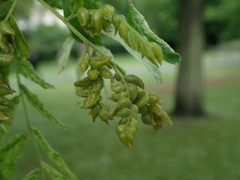
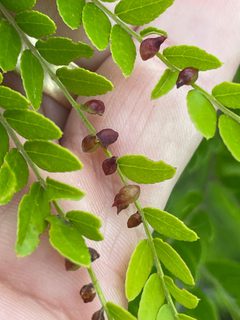
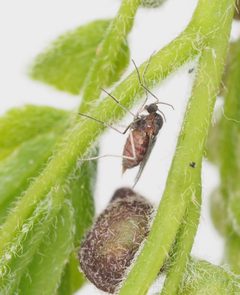
are tiny, delicate flies typical of gall midges, with reduced wing venation and long, bead-like . The is most readily identified by its distinctive galls: small, pod-shaped or berry-like structures that form on honey locust leaflets. These galls are green when young and may turn brown with age; they contain a single larva each. The galls superficially resemble fruits but are attached to leaf tissue rather than stems.
Images
Habitat
Associated with honey locust trees in urban plantings, parks, and ornamental landscapes. The thrives in temperate climates where its is cultivated. In North America, it occurs in natural and planted stands of Gleditsia triacanthos; in Europe, it is restricted to urban and suburban environments where ornamental honey locusts are grown.
Distribution
Native to North America: recorded from California, Idaho, North Dakota, Oregon, South Dakota, Wyoming (USA), and Ontario (Canada). Introduced to Europe: established in Austria, Belgium, Croatia, Czech Republic, Denmark, France, Greece, Hungary, Italy, Luxembourg, Netherlands, Poland, Serbia, Slovakia, Slovenia, Spain, Sweden, Switzerland, and the United Kingdom (England and Wales). Also recorded in Turkey.
Seasonality
emerge in spring and early summer, coinciding with honey locust leaf development. Gall formation occurs as new foliage expands. Larvae develop within galls through summer, with mature larvae dropping to the soil to pupate. occurs in soil, with adults emerging the following spring.
Diet
Larvae feed on plant tissue within galls induced on honey locust leaflets. do not feed; their mouthparts are reduced or non-functional, as is typical for many Cecidomyiidae.
Host Associations
- Gleditsia triacanthos - gall inducerThe sole known ; larvae induce pod-shaped galls on leaflets.
Life Cycle
are laid on developing honey locust leaflets. Larvae hatch and induce gall formation, developing within individual pod-like galls. Mature larvae exit galls and drop to the ground, burrowing into soil to pupate. Pupae overwinter in soil. emerge in spring, often synchronizing with bud break.
Behavior
Females oviposit on young leaf tissue, triggering gall induction through chemical manipulation of plant growth. Larvae are sedentary, developing entirely within their individual galls. Mature larvae actively exit galls and burrow into soil for . are weak fliers and likely disperse short distances; long-range spread occurs primarily through human transport of infested plant material.
Ecological Role
Acts as a phytophagous on honey locust, with minimal apparent impact on native in its introduced range due to restriction to cultivated . The galls may provide microhabitats for incidental or , though specific associates are poorly documented.
Human Relevance
Considered a minor ornamental pest due to gall formation on honey locust foliage, which can cause aesthetic damage and premature leaf drop in heavy . Management in urban settings may involve pruning of infested branches or soil treatments targeting pupae, though the is rarely a priority for intensive control.
Similar Taxa
- Dasineura investitaAlso in Cecidomyiidae and induces similar berry-like galls, but on wood nettle (Laportea canadensis) rather than honey locust; plant distinguishes the .
- Other Dasineura spp. on GleditsiaSome may occur on honey locust; precise identification requires examination of or molecular analysis, as gall morphology alone may not distinguish all .
- Contarinia spp.Related gall midges that may cause similar foliar distortions on leguminous ; distinguished by gall structure details and genitalia.