
Asteromyia euthamiae
Gagné, 1968
Euthamia leaf gall midge
Asteromyia euthamiae is a gall midge described by Raymond Gagné in 1968. It is widely distributed across northern North America, where it induces leaf galls on Euthamia plants. The species is notable for producing distinctively colored galls with dark bodies and contrasting marginal bands.
Pronunciation
How to pronounce Asteromyia euthamiae: /ˌæstɛroʊˈmaɪə juːˈθeɪmi.aɪ/
These audio files are automatically generated. While they are not always 100% accurate, they are a good starting point.
Identification
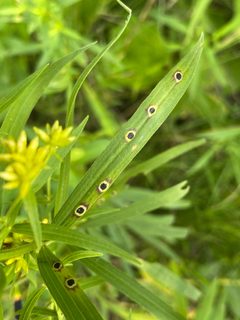
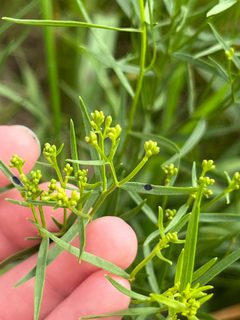
Distinguished from other Asteromyia by specificity to Euthamia (flat-topped goldenrod) rather than Solidago or other Asteraceae. Galls differ from those of Asteromyia carbonifera (which occur on Solidago) in host association. The distinctive dark gall with pale or colored margin separates it from many other cecidomyiid leaf galls on Asteraceae. require microscopic examination for definitive identification.
Images
Appearance
typical of minute cecidomyiid flies; body length approximately 2–3 mm. Wing venation reduced, characteristic of . Larvae are small, legless, and maggot-like. The induced galls are the most visible feature: 3–10 mm in length, rounded to elliptical or elongate-elliptical in shape depending on leaf width. Gall coloration is predominantly black with a narrow marginal band in yellow, white, or purple.
Habitat
Associated with Euthamia plants in open, sunny including meadows, prairies, roadsides, and disturbed areas where flat-topped goldenrods grow.
Distribution
Widely distributed in northern North America. Documented from Vermont and across the United States; range corresponds with distribution of Euthamia .
Diet
Larvae feed internally within leaf galls on Euthamia tissue. Specific feeding habits have not been documented.
Host Associations
- Euthamia caroliniana - gall inducer plant
- Euthamia graminifolia - gall inducer plant
- Euthamia leptocephala - gall inducer plant
Life Cycle
Has been observed to induce galls on Euthamia leaves. Complete details including number of per year and stage have not been documented.
Behavior
Females oviposit into Euthamia leaf tissue, inducing gall formation. Larvae develop within galls, which provide protection and nutrition.
Ecological Role
As a gall inducer, modifies plant leaf and creates for potential and . Specific ecological impacts on Euthamia have not been quantified.
Human Relevance
Minor economic or agricultural significance. Occasionally encountered by botanists and naturalists studying goldenrod galls. Serves as a subject for studies on plant-insect interactions and gall induction mechanisms.
Similar Taxa
- Asteromyia carboniferaAlso produces dark leaf galls on Asteraceae, but restricted to Solidago (goldenrod) rather than Euthamia; gall and host association distinguish the two .
- Other Asteromyia speciesNumerous induce galls on various Asteraceae; plant identity is the primary field character for separation.
More Details
Nomenclature
The specific epithet euthamiae directly references the Euthamia, reflecting the tight host association that defines this .
Gall Variation
Gall shape varies with leaf width of the plant: broader leaves produce more rounded galls, while narrow leaves produce elongate-elliptical galls.