
Resseliella
Seitner, 1906
Species Guides
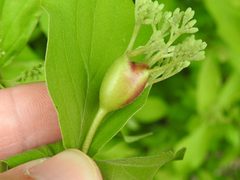
4- Resseliella clavula(Dogwood Club Gall Midge)
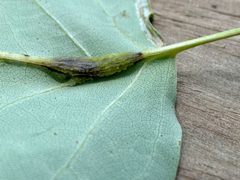
- Resseliella globosa(Copperleaf stem gall midge)
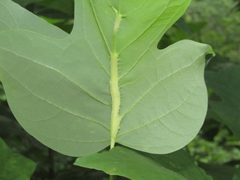
- Resseliella liriodendri(tulip tree leaf spot gall midge)
- Resseliella tulipiferae
Resseliella is a of gall midges in the Cecidomyiidae containing at least 50 described . The genus includes economically significant agricultural pests, notably R. maxima (soybean gall midge) which threatens soybean production in the north-central United States, as well as R. citrifrugis, a major citrus pest in China, and R. theobaldi (raspberry cane ), an important pest of cultivated red raspberry in Europe. Some species exhibit mutualistic relationships with plants, such as R. kadsurae which pollinates Kadsura longipedunculata in China.
Pronunciation
How to pronounce Resseliella: /rɛˌsɛliˈɛlə/
These audio files are automatically generated. While they are not always 100% accurate, they are a good starting point.
Identification
Gall midges in this are small, delicate flies typically 2-5 mm in length. often have banded legs and mottled or patterned wings. Larvae are usually maggot-like and often brightly colored; R. maxima larvae are distinctive bright orange. identification requires examination of male genitalia, flagellomere structure, and wing venation patterns. R. kadsurae is uniquely characterized by gynecoid male flagellomeres and a transverse bridge-like structure on the male hypoproct.
Images
Habitat
vary by : agricultural fields for pest species (soybean fields for R. maxima, citrus groves for R. citrifrugis, raspberry plantations for R. theobaldi); natural and semi-natural for non-pest species including forests where R. kadsurae visits flowers of Schisandraceae.
Distribution
distribution with in North America (R. maxima in Iowa, Minnesota, Nebraska, Missouri, South Dakota; R. clavula in eastern North America), Europe (R. theobaldi), China (R. citrifrugis, R. kadsurae), Central Asia (R. oculiperda in Kazakhstan), and Africa (R. salvadorae in Sudan). GBIF records indicate presence in Denmark, Norway, Sweden, and Vermont, USA.
Host Associations
- Glycine max - herbivoreR. maxima larvae feed on soybean stems
- Citrus spp. - herbivoreR. citrifrugis larvae feed inside citrus fruit including pummelo, sweet orange, tangerine, mandarin, and trifoliate orange
- Rubus idaeus - herbivoreR. theobaldi larvae feed in raspberry cane bases
- Kadsura longipedunculata - R. kadsurae visits flowers and acts as ; mating occurs at dusk on non-sticky spider webs
- Malus domestica - herbivoreR. oculiperda (red bud borer) develops in apple branches
- Cornus florida - herbivoreR. clavula induces club galls on flowering dogwood
- Salvadora persica - herbivoreR. salvadorae induces stem and leaf galls
Life Cycle
R. maxima completes three per year in the Midwest; mature larvae drop from stems to pupate in soil, with the last generation in silken cocoons and pupating in spring. R. theobaldi has a complex synchronized with raspberry cane growth. R. kadsurae stages and complete remain unknown.
Behavior
R. maxima females oviposit in natural fissures below the cotyledonary node of soybean stems during early vegetative growth stages. R. kadsurae is with mating occurring at dusk; males and females hang on opposite sides of non-sticky old spider webs in venter-to-venter position. Larval feeding of pest induces characteristic plant damage: necrotic and stem breakage in soybean, premature fruit drop in citrus, cane death in raspberry.
Ecological Role
Agricultural pests causing significant yield losses; R. maxima can cause 18-31% yield loss across entire fields with complete loss near field edges. Some serve as . Gall formation creates for secondary organisms. Species in this support including Platygastridae (Synopeas maximum, S. ruficoxum) and Eulophidae (Aprostocetus epicharmus). R. oculiperda has been identified as a of Erwinia amylovora, the causative agent of bacterial fire blight of fruit trees.
Human Relevance
Major economic impact through agricultural damage. R. maxima emerged as a serious soybean pest in 2018 in the north-central US with no reliable management methods currently available; research focuses on using , cultural control (hilling at V2 growth stage), and . R. citrifrugis threatens citrus production in China with losses of 10-100% depending on management. R. theobaldi has been managed in Europe for over 50 years. of R. maxima sequenced (206 Mb, 14,798 genes) to support research on , genetics, and resistance.
Similar Taxa
- Orseolia oryzaeAsian rice gall midge; R. maxima mitogenome shares highest identity with this , but differs in association (rice vs. soybean) and geographic distribution (Asia vs. North America)
- Other Cecidomyiidae generaResseliella can be distinguished by combination of flagellomere structure, wing patterning, and male genitalia ; molecular data (COI) supports phylogenetic placement within the
Sources and further reading
- BugGuide
- Wikipedia
- GBIF taxonomy match
- iNaturalist taxon
- NCBI Taxonomy
- Catalogue of Life
- From curiosity to control: A new wasp joins the fight against soybean gall midge | Blog
- From Curiosity to Control: A New Wasp Joins the Fight Against Soybean Gall Midge
- Soybean Gall Midge: Discovery of a Delicate and Destructive New Species
- An Old Trick for a New Pest: Well-Timed Hilling Stymies Soybean Gall Midge
- New species of parasitic wasp associated with soybean pest
- Resseliella citrifrugis Jiang
- The Genome of the Soybean Gall Midge ( Resseliella maxima )
- The genome of the soybean gall midge ( Resseliella maxima )
- ОКулировочная галлица Resseliella oculiperda(Rübsaamen, 1893) (Diptera, Cecidomyiidae) – НОВЫЙ ПЕРЕНОСЧИК ВОЗБУДИТЕЛЯ БАКТЕРИАЛЬНОГО ОЖОГА (ERWINIA AMYLOVORA) ПЛОДОВЫХ
- Changes in Reproduction and Architecture in Flowering Dogwood, Cornus florida, after Attack by the Dogwood Club Gall, Resseliella clavula
- Predation behaviors of Pterostichus melanarius adults on larvae of the soybean gall midge, Resseliella maxima
- Interrelationship between the raspberry cane midge, Resseliella theobaldi (Diptera: Cecidomyiidae) and its parasitoid, Aprostocetus epicharmus (Hymenoptera: Eulophidae)
- Fungi on red raspberry from lesions associated with feeding wounds of cane midge (Resseliella theobaldi)
- Predation of Pterostichus melanarius on cocoons of soybean gall midge, Resseliella maxima
- First record of Resseliella salvadorae (Rao) (Diptera: Cecidomyiidae) and its parasitoid from stem and leaf galls of Salvadora persica L. Sudan
- Description of a new species of the genus Resseliella (Diptera: Cecidomyiidae), a pollinator of Kadsura longipedunculata (Schisandraceae) in China, with comments on its flower‐visiting habit
- Synopeas maximum Awad & Talamas (Hymenoptera, Platygastridae): a new species of parasitoid associated with soybean gall midge, Resseliella maxima Gagné (Diptera, Cecidomyiidae)
- A Brief Review ofResseliella citrifrugis(Diptera: Cecidomyiidae), a Lesser-Known Destructive Citrus Fruit Pest