
Caryomyia caryae
(Osten Sacken, 1862)
Hickory Sticky Globe Gall Midge
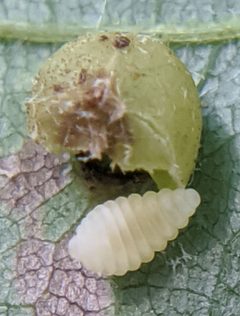
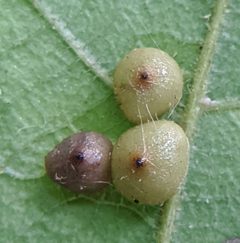
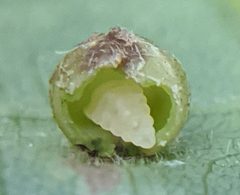
Caryomyia caryae is a gall midge in the Cecidomyiidae that induces distinctive globular galls on hickory leaves. The is one of several gall-forming insects associated with Carya species in eastern North America. Like other cecidomyiids, it manipulates plant tissue development through chemical secretions to create protective structures for its larvae.
Pronunciation
How to pronounce Caryomyia caryae: //ˌkæri.oʊˈmaɪ.a ˈkɛəri.aɪ//
These audio files are automatically generated. While they are not always 100% accurate, they are a good starting point.
Identification
The galls of Caryomyia caryae are small, globular structures with a pointed tip, typically found on the undersides of hickory leaves. These sticky galls can be distinguished from other hickory galls by their compact spherical shape and point. Similar galls formed by Phylloxera on hickory tend to be larger, more irregular, or located on different plant parts such as petioles and leaf .
Images
Habitat
Associated with hickory trees (Carya spp.), particularly in deciduous forest where trees occur.
Distribution
Eastern North America, where hickory are native.
Seasonality
and gall formation occur during spring when hickory leaf buds break and new foliage develops.
Host Associations
- Carya - gall induction on leavesForms galls on leaf undersides; specific hickory not documented in available sources
Ecological Role
As a gall inducer, the creates novel microhabitats on hickory leaves. These galls may provide shelter for other organisms and represent a form of plant-insect interaction that, while diverting resources, typically causes minimal harm to established trees.
Similar Taxa
- Phylloxera caryaecaulisAlso forms galls on hickory, but produces larger, more irregular globular galls typically on leaf petioles and rather than leaf undersides; belongs to a different insect order (Hemiptera: Sternorrhyncha vs. Diptera)
More Details
Gall morphology
The specific epithet 'caryae' reflects the -level association with Carya. The 'sticky globe' refers to the gall's texture and shape.
Sources and further reading
- BugGuide
- Wikipedia
- GBIF taxonomy match
- iNaturalist taxon
- Catalogue of Life
- Gall darn it! Gall insects on hickory, oak, and elm, Phylloxera caryaecaulis, Andricus palustris, Colopha ulmicola — Bug of the Week
- When is a locust borer not a locust borer? | Beetles In The Bush
- Bug Eric: February 2009
- Pseudoscorpiones | Beetles In The Bush
- Megacyllene comanchei revisited | Beetles In The Bush