
Bruggmanniella
Tavares, 1909
Species Guides
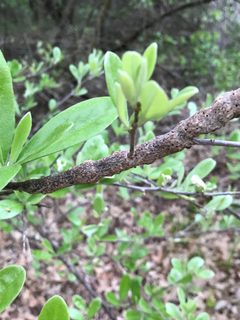
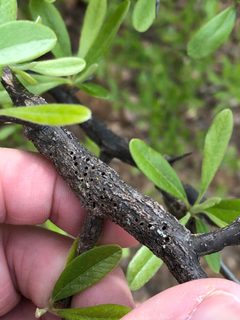
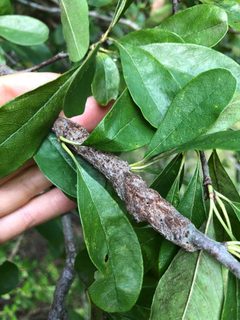
1- Bruggmanniella bumeliae(Bumelia gall midge)
Bruggmanniella is a of gall midges (Cecidomyiidae: Asphondyliini) comprising approximately ten that induce galls on various plants. The genus is characterized by distinctive morphological features including three-segmented palpi, simple tarsal claws, and male gonostyli with teeth completely divided mesally. Species induce galls on stems, twigs, flower buds, ovaries, and fruits of diverse plant including Lauraceae, Malpighiaceae, Annonaceae, Fabaceae, Celastraceae, Dilleniaceae, and Sapotaceae. Phylogenetic analysis confirms Bruggmanniella as a monophyletic Neotropical lineage, with Asian species reassigned to the genus Odontokeros.
Pronunciation
How to pronounce Bruggmanniella: //bruːɡˌmæn.iˈɛl.lə//
These audio files are automatically generated. While they are not always 100% accurate, they are a good starting point.
Identification
-level identification relies on morphological characters: three-segmented palpi; simple tarsal claws; male gonostyli with tooth completely divided mesally forming two separate teeth; female segment 8 with -like lobes; pupal antennal horns well-developed with no frontal horns; tiny and numerous abdominal spines; four-toothed larval spatula. -level identification requires examination of gall , plant association, and detailed morphological analysis of and stages.
Images
Habitat
occupy diverse Neotropical vegetation types including Brazilian savanna (cerrado), gallery forests, seasonally dry forests, cerradão, and cerrado sensu stricto. Specific requirements vary by plant association; some species occur in commercial agricultural settings such as avocado orchards.
Distribution
Neotropical region, with confirmed records from Brazil (Minas Gerais, first state report), Mexico (Morelos), and broader Neotropical distribution. Historically reported from southern Nearctic, Palaearctic, and Oriental regions, but phylogenetic revision reassigned Asian/Oriental/Palearctic to the Odontokeros, restricting Bruggmanniella to the Neotropics.
Host Associations
- Persea americana - cv. Hass; avocado ovary fly
- Doliocarpus dentatus - stem gall induction; first report for Dilleniaceae
- Litsea acuminata - leaf gall induction (cup-shaped and umbrella-shaped )
- Byrsonima - Malpighiaceae
- Duguetia - Annonaceae
- Inga - Fabaceae
- Maytenus - Celastraceae
- Actinodaphne - Lauraceae
- Cinnamomum - Lauraceae
- Sideroxylon - Sapotaceae
Life Cycle
Holometabolous with complete : , larva, pupa, . Larval development occurs within plant-induced galls on stems, leaves, flower buds, ovaries, or fruits. Adults emerge from galls through small lateral holes in gall walls. Specific timing varies by and .
Behavior
females possess elongated ovipositors (rigid portion approximately 1.28 mm, 1.54–1.66 times length of sternite 7) for inserting into plant tissue. Gall induction triggers callus tissue formation at insertion points, which prevents subsequent gall induction at the same site. Adults of some are difficult to capture in the field and may require sticky colored traps or collection of infested plant material for detection.
Ecological Role
Gall inducer that alters plant and creates novel microhabitats with distinctive internal tissue characteristics (white soft tissue with high water content). Gall formation can significantly impact host plant reproductive output; some are recognized as agricultural pests threatening crop yield.
Human Relevance
Bruggmanniella perseae (avocado ovary fly) is an economically significant pest of commercial Hass avocado production in Mexico, causing fruit deformation and yield loss if uncontrolled at the beginning of fruit set. Detection and monitoring are challenging due to difficulty in field capture of . Research on this contributes to understanding gall inducer- plant and informs strategies.
Similar Taxa
- OdontokerosPreviously congeneric; Asian/Oriental/Palearctic reassigned to Odontokeros based on phylogenetic analysis, leaving Bruggmanniella as exclusively Neotropical
- PseudasphondyliaClosely related within Asphondyliini; evolutionary relationships and morphological boundaries discussed in phylogenetic studies
- IlliciomyiaClosely related within Asphondyliini; shares evolutionary history and morphological similarities requiring phylogenetic analysis for delimitation
More Details
Gall polymorphism
B. litseae exhibits remarkable intraspecific gall on Litsea acuminata, producing both cup-shaped and umbrella-shaped leaf galls with intermediate forms, demonstrating that divergent gall morphologies can be generated by a single rather than multiple cryptic species.
Taxonomic history
The has undergone significant revision based on cladistic and phylogenetic analyses; seven new were described between 2019 and 2020, and the geographic scope was narrowed to the Neotropics through exclusion of Asian species.
Sources and further reading
- BugGuide
- GBIF taxonomy match
- iNaturalist taxon
- NCBI Taxonomy
- Catalogue of Life
- Detection of Bruggmanniella perseae in Hass avocado (Persea americana cv. Hass) in Morelos, Mexico
- A new species of Bruggmanniella (Diptera, Cecidomyiidae, Asphondyliini) associated with Doliocarpus dentatus (Dilleniaceae) in Brazil
- Another step towards understanding evolutionary changes in Bruggmanniella Tavares, 1909 group (Diptera, Cecidomyiidae, Asphondyliini)
- Does the gall-forming cecidomyiid enhance host plant leaves and their phytochemicals? A case study of Bruggmanniella litseae (Diptera: Cecidomyiidae)
- Host relations and colonization of TaiwaneseBruggmanniellaspecies (Diptera: Cecdomyiidae) onLitseaLam. andCinnamomumSchaeffer (Lauraceae)
- Cladistic analysis of the genus Bruggmanniella Tavares (Diptera, Cecicomyiidae, Asphondyliini) with evolutionary inferences on the gall inducer-host plant association and description of a new Brazilian species
- Leaf gall polymorphism and molecular phylogeny of a new Bruggmanniella species (Diptera: Cecidomyiidae: Asphondyliini) associated with Litsea acuminata (Lauraceae) in Taiwan, with ecological comparisons and a species description