
Scatopse notata
(Linnaeus, 1758)
Black Compost Fly
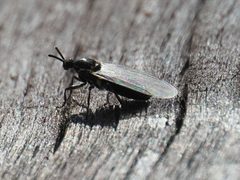
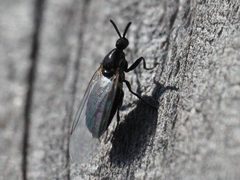
Scatopse notata is a minute dipteran in the Scatopsidae, commonly known as the Black Compost Fly. The occurs across the Palearctic region and has been recorded from isolated subantarctic islands including South Georgia and Amsterdam Island. Larvae develop in decomposing organic matter and serve as for the microsporidian Plistophora scatopsi, which infects the mid-gut epithelium across all life stages.
Pronunciation
How to pronounce Scatopse notata: /skəˈtɒpsi noʊˈteɪtə/
These audio files are automatically generated. While they are not always 100% accurate, they are a good starting point.
Identification
Separation from other Scatopsidae requires microscopic examination of male genitalia and specific setal patterns. The Scatopsidae is distinguished from other nematoceran Diptera by the humpbacked and characteristic wing venation with reduced crossveins.
Images
Appearance
are small, dark-colored flies typical of the Scatopsidae. Members of this family generally have a humpbacked , short , and reduced wing venation. Specific diagnostic features for S. notata require examination of genitalia and detailed chaetotaxy.
Habitat
Larvae develop in decomposing organic matter including compost and decaying vegetation. are found in association with larval .
Distribution
Palearctic distribution including Europe and Asia. Records from South Georgia and Amsterdam Island suggest capacity for to isolated subantarctic localities. Specific national records include Denmark, Japan, and Norway.
Host Associations
- Plistophora scatopsi - microsporidian Infects mid-gut epithelium and caeca of larvae; present also in pupae and flies, indicating vertical or persistent
Life Cycle
Complete with , larva, pupa, and stages. Larvae develop in decomposing organic substrates. The microsporidian Plistophora scatopsi has been observed in larval, pupal, and adult stages, suggesting transstadial persistence or .
Similar Taxa
- Other ScatopsidaeShare humpbacked and reduced wing venation; require genitalia examination for -level separation
More Details
Parasite Host Record
S. notata is the type for Plistophora scatopsi sp.nov., described from mid-gut in larvae. This represents a documented case of microsporidian in Scatopsidae.
Sources and further reading
- BugGuide
- Wikipedia
- GBIF taxonomy match
- iNaturalist taxon
- NCBI Taxonomy
- Catalogue of Life
- Bug Eric: Missing Sector Orbweaver, Zygiella x-notata
- Bug Eric: Spider Sunday: Triangulate Cobweb Weaver
- The morphology and life cycle of Plistophora scatopsi sp.nov., a microsporidian parasitic in the mid-gut of Scatopse notata Mg. (Diptera, Nematocera)