
Bibio xanthopus
Wiedemann, 1828
yellow-footed March fly
Bibio xanthopus, commonly known as the yellow-footed March fly, is a of March fly in the Bibionidae first described by Wiedemann in 1828. It is one of the most common species of Bibio in North America. The species exhibits considerable size variation and displays distinct in and wing coloration.
Pronunciation
How to pronounce Bibio xanthopus: /ˈbɪbi.oʊ zænˈθoʊ.pəs/
These audio files are automatically generated. While they are not always 100% accurate, they are a good starting point.
Identification
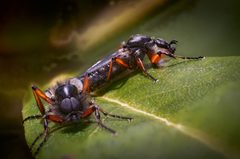
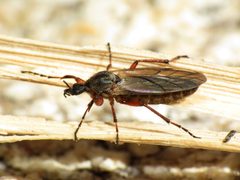
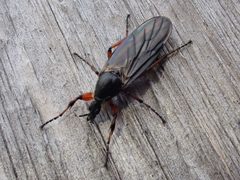
Distinguished from similar Bibio by the combination of legs and black body with pale pile. Males are easily recognized by their large ; females by their small and black wings. Separated from the related Dilophus by the presence of long, downcurved spurs at the end of the tibia on the first leg (Dilophus has a ring of shorter teeth instead).
Images
Appearance
Body black with pale colored pile. Legs predominantly (reddish-brown). Females have black wings. Males have large, spherical with that meet at the top of the head. Females have proportionally tiny heads relative to body size. Wingspan ranges from 5.5 to 9.5 mm. Body length ranges from 8 to 11 mm. Larvae (maggots) are 10 mm in length with warty skin and a pair of .
Distribution
North America.
Diet
Larvae feed on roots. of related Bibio have been observed feeding on nectar.
Life Cycle
Females use stout spurs on the forelegs to dig into soil and deposit in masses of 200-300. Larval stage feeds on roots. Mature larvae likely overwinter, pupating in early spring.
Behavior
Males gather in swarms to attract females for mating. Females select mates from these swarming .
Ecological Role
Larvae contribute to soil nutrient cycling through root feeding activity. may serve as when feeding on nectar.
Similar Taxa
- Dilophus speciesSimilar body form but distinguished by shorter leg spurs arranged in a ring rather than long downcurved spurs, usually smaller and less robust, and frequently reddish rather than black.
- Plecia nearctica (lovebug)Same but distinguished by red , habit of flying in copula for extended periods, and primarily southern distribution.
More Details
Taxonomic history
Bibio xanthopus was first described by Wiedemann in 1828. Many former '' in Bibio were synonymized based on variable characters such as leg color and hair ; reliable identification often requires examination of male genitalia.