
Mydas arizonensis
Wilcox, Papavero & Pimentel, 1989
Pronunciation
How to pronounce Mydas arizonensis: /ˈmaɪ.dəs ˌæ.rɪ.zoʊˈnɛn.sɪs/
These audio files are automatically generated. While they are not always 100% accurate, they are a good starting point.
Identification
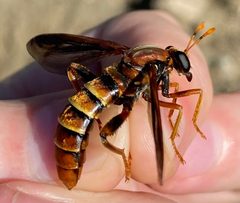
Mydas flies are distinguished from similar-appearing robber flies (Asilidae) by their elongate, clubbed —robber flies possess short antennae. Within Mydidae, identification typically requires examination of wing venation, abdominal coloration patterns, and male genitalia. Mydas arizonensis would be expected to show the -typical large size, -like coloration, and the characteristic mydas antennal structure.
Images
Distribution
United States, specifically Arizona and adjacent southwestern regions.
Similar Taxa
- Ospriocerus abdominalisSimilar large, -mimicking appearance with black body and red abdominal coloration, but distinguished by short (robber fly Asilidae) versus the elongate clubbed antennae of Mydas arizonensis.
- Wyliea mydasAnother large western robber fly with -mimicking black and red coloration; differs in short and entirely black with red wings, versus Mydas arizonensis which has clubbed antennae.
More Details
Taxonomic Context
The Mydas contains some of the largest flies in North America, with many exhibiting of spider wasps (Pompilidae). The Mydidae is relatively small, containing approximately 500 species worldwide, with highest diversity in arid and semi-arid regions.
Data Limitations
Detailed biological information for Mydas arizonensis specifically appears sparse in accessible literature. Much of what is known about mydas fly derives from studies of more common or widespread in the .
Sources and further reading
- BugGuide
- Wikipedia
- GBIF taxonomy match
- iNaturalist taxon
- NCBI Taxonomy
- Catalogue of Life
- Bug Eric: Wasp Wednesday: Polistes arizonensis
- Destination Sonoran Desert: A time to sting for the Giant Hairy Desert Scorpion, 'Hadrurus arizonensis' — Bug of the Week
- Bug Eric: A Spider Surprise
- Ospriocerus abdominalis | Beetles In The Bush
- robber flies | Beetles In The Bush | Page 3