
Wyliea mydas
(Brauer, 1885)
Mydas Bronzewing
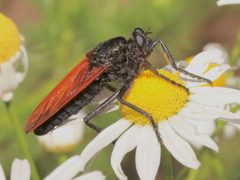
Wyliea mydas is a large western robber fly ( Asilidae) noted for its striking -mimetic coloration. The exhibits a wholly black and vivid red wings, distinguishing it from similar mimetic flies. It has been documented from western North America, with its range extending into Mexico. The species is considered among the most visually impressive robber flies due to its bold aposematic coloration, presumably modeled after spider wasps in the Pepsis and Hemipepsis.
Pronunciation
How to pronounce Wyliea mydas: //ˈwaɪliə ˈmaɪdæs//
These audio files are automatically generated. While they are not always 100% accurate, they are a good starting point.
Identification
Distinguished from the related Ospriocerus abdominalis by its wholly black versus red abdominal coloration; O. abdominalis has black body and wings with red on the abdomen. Separated from true mydas flies ( Mydidae) by short —mydas flies possess elongate clubbed antennae. The red-winged, black-bodied combination is distinctive among western North American robber flies.
Images
Appearance
Large-bodied robber fly with distinctive -mimetic coloration. entirely black. Wings bright red. Body robust with typical asilid features including large , strong spiny legs adapted for prey capture, and a concave facial profile between the . short, not clubbed (distinguishing it from true mydas flies in Mydidae).
Habitat
Western North American grasslands and open . Specific microhabitat preferences within these have not been documented.
Distribution
Western North America, ranging into Mexico. Precise eastern distributional limits are unclear from available records.
Behavior
has been observed to include bold, conspicuous in open areas—consistent with aposematic or mimetic protection. Specific prey capture behaviors, perching habits, or territoriality have not been documented.
Ecological Role
Presumed aerial as , based on -level characteristics of Asilidae. Specific ecological functions have not been studied.
Human Relevance
None documented. The ' striking appearance makes it a subject of interest for insect photographers and naturalists.
Similar Taxa
- Ospriocerus abdominalisSimilar large size and -mimetic coloration with black body, but O. abdominalis has black wings and red versus W. mydas with red wings and black abdomen.
- Mydas clavatusSimilar reference and large size; however, M. clavatus is in Mydidae with elongate clubbed , while W. mydas has short antennae typical of Asilidae.
More Details
Taxonomic note
The name Wyliea has been synonymized with Wilcoxius in some taxonomic treatments (e.g., GBIF), though Wyliea remains in common use and is recognized by NCBI and iNaturalist.
Mimicry
The ' coloration is presumed to represent of spider wasps (Pompilidae: Pepsis, Hemipepsis), which are formidable stinging insects. This mimicry may confer protection from vertebrate .