
Triploechus
Edwards, 1936
Species Guides
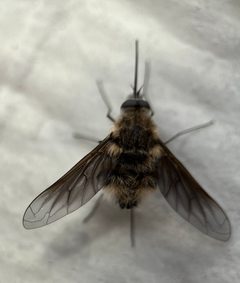
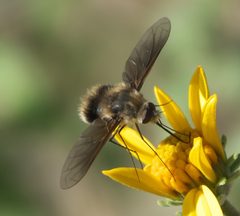
1Triploechus is a of bee flies ( Bombyliidae) containing approximately 10 described . The genus was established by Edwards in 1936 and is classified within the tribe Bombyliini. Species are distributed across the New World, with records from North and South America. As with other bee flies, members are likely , though specific relationships remain poorly documented.
Pronunciation
How to pronounce Triploechus: /trɪˈploʊ.kəs/
These audio files are automatically generated. While they are not always 100% accurate, they are a good starting point.
Identification
Triploechus can be distinguished from other Bombyliidae by wing venation patterns, particularly the arrangement of in the portion of the wing. The name refers to the triple swelling (Greek: triplo- echus) of certain wing veins, a diagnostic character. Edwards (1937) noted narrow-winged forms in T. angustipennis, while Hall (1975) described luridus and stagei based on coloration and structural differences. Exact separation from related genera such as Bombylius requires examination of vein R4+5 branching and the presence of specific spurs on the hind tibia.
Images
Distribution
New World distribution, with recorded from North America (United States) and South America (Chile, Argentina). Specific range data: T. angustipennis, T. divisus, T. novus, T. sackeni, T. stagei, and T. vierecki occur in the United States; T. bellus and T. heteronevrus are South American; T. luridus and T. pallipes have restricted distributions.
Similar Taxa
- BombyliusSimilar bee fly and shared tribe Bombyliini; distinguished by wing venation details and tibial spurs
- SystoechusOverlapping distribution and general Bombyliidae appearance; separated by wing swelling patterns characteristic of Triploechus
More Details
Taxonomic History
Authorship dates vary in sources: Edwards 1936 (Catalogue of Life) versus 1937 (GBIF). The discrepancy likely reflects publication versus description dates. Hall (1975) significantly revised the , adding two new (T. luridus, T. stagei) and clarifying relationships among previously described .