
Exoprosopa fascipennis
(Say, 1824)
Band-winged Bee Fly
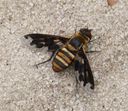
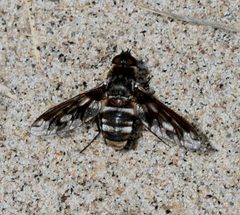
Exoprosopa fascipennis is a bee fly in the Bombyliidae, commonly known as the Band-winged Bee Fly. It is widely distributed across North America, occurring throughout most of southern Canada, the United States, and Cuba. The species is notable for its larval of solitary larvae, a characteristic trait within this .
Pronunciation
How to pronounce Exoprosopa fascipennis: //ɛk.soʊˈpɹoʊ.sə.pə ˌfæs.ɪˈpɛn.ɪs//
These audio files are automatically generated. While they are not always 100% accurate, they are a good starting point.
Identification
The specific epithet "fascipennis" (band-winged) suggests distinctive wing patterning with banded or fasciated markings. As a member of Exoprosopa, it likely exhibits the robust, -mimicking body form typical of the , with a stout and . Positive identification requires examination of wing venation and body setation patterns; the banded wing pattern distinguishes it from many .
Images
Habitat
Associated with environments supporting solitary , which serve as larval . Specific preferences are not well documented.
Distribution
Widespread in North America, ranging across most of southern Canada and the continental United States. Also reported from Cuba.
Diet
feeding habits are not documented. Larvae are of solitary larvae.
Host Associations
- solitary wasp larvae - larval Larvae are
Life Cycle
Larvae develop as on solitary larvae. Details of deposition, , and are not documented.
Ecological Role
Acts as a of solitary , potentially influencing wasp . The ecological impact of this has not been quantified.
Similar Taxa
- Other Exoprosopa speciesSimilar -mimicking ; distinguished by wing banding pattern and specific wing venation details
- Other BombyliidaeGeneral bee fly appearance; Exoprosopa are typically more robust with distinctive wing patterns
More Details
Taxonomic history
Described by Thomas Say in 1824, making it one of the earlier described North American bee fly .
Observation frequency
With over 1,600 iNaturalist observations, it is among the more frequently documented Exoprosopa , suggesting it is relatively conspicuous or abundant within its range.