
Anthrax argyropygus
Wiedemann, 1828
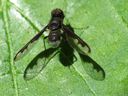
Anthrax argyropygus is a bee fly in the Bombyliidae, characterized by its lifestyle. The Anthrax contains species known to attack the larvae of ground-nesting insects, including tiger beetles and solitary bees. are typically observed visiting flowers for nectar, where their hairy bodies inadvertently collect and transfer pollen. The species name 'argyropygus' refers to the silvery appearance of the . Like other bee flies, this species exhibits of bees, possessing a single pair of wings and a long adapted for nectar feeding.


Pronunciation
How to pronounce Anthrax argyropygus: /ˈænθræks ˌɑrɡɪrəˈpaɪɡəs/
These audio files are automatically generated. While they are not always 100% accurate, they are a good starting point.
Identification
Distinguished from other Anthrax by the silvery or argent coloration of the (the 'argyropygus' or silver-rumped characteristic). Wing venation patterns, particularly the location of the r-m , may be used to distinguish Anthrax from related such as Systoechus. are active in spring, which may help separate from fall-active species in other genera. Final identification typically requires examination of genitalia or expert confirmation.
Images
Habitat
frequent meadows and open areas with abundant flowering plants. Larval is dependent on availability, typically associated with ground-nesting insects in sandy or well-drained soils.
Distribution
Distribution records are limited in the provided sources. The has been documented in North America based on iNaturalist observations (626 records), but specific range boundaries are not detailed in available literature.
Seasonality
are active in spring. This seasonal pattern distinguishes Anthrax from some related such as Systoechus, which tend to be active in fall.
Diet
feed on nectar from flowers using their elongated . Larvae are ; specific for A. argyropygus are not documented in the provided sources, but attack larvae of tiger beetles () and solitary bees (Halictidae, Colletidae, Andrenidae).
Life Cycle
Complete with , larval, pupal, and stages. Females deposit eggs near or in burrows. Larvae attach externally to host larvae and feed as ectoparasitoids, eventually killing the host. Specific details for A. argyropygus are not documented; the is inferred from congeneric .
Behavior
are rapid, agile fliers often mistaken for bees due to their hairy appearance and hovering near flowers. They perform pre-flight warm-up by rapidly fluttering wings. Females exhibit -following , tracking solitary bees back to their nests to deposit .
Ecological Role
function as through incidental pollen transfer on their hairy bodies while feeding on nectar. Larvae act as , potentially regulating of ground-nesting insects. The contributes to complexity in meadow and grassland .
Human Relevance
provide pollination services. No direct economic impact is documented; the is not known to be a pest. The -mimicking appearance may cause temporary confusion with stinging insects, but bee flies are harmless to humans.
Similar Taxa
- Bombylius majorAlso a bee fly with long and -mimicking appearance, but lacks the silvery abdominal coloration of A. argyropygus and is generally larger.
- Systoechus spp.Similar bee flies distinguished by wing venation (position of r-m ) and typically fall-active rather than spring-active.
- Anthrax georgicus with similar lifestyle on tiger beetles, but differs in abdominal coloration and specific associations.
Misconceptions
Frequently mistaken for bees due to hairy appearance and flower-visiting ; the single pair of wings and lack of a constricted waist distinguish bee flies from true Hymenoptera.
More Details
Etymology
The specific epithet 'argyropygus' derives from Greek 'argyros' (silver) and 'pyge' (rump or ), referring to the distinctive silvery coloration of the .
Taxonomic note
The Anthrax has undergone taxonomic revisions; some sources may list synonyms or related names. The was described by Wiedemann in 1828.
Sources and further reading
- BugGuide
- GBIF taxonomy match
- iNaturalist taxon
- Catalogue of Life
- Bombyliidae | Beetles In The Bush | Page 2
- ID Challenge #11 | Beetles In The Bush
- Ground nesting bees beware of the bee fly: Bombyliidae — Bug of the Week
- Danger afoot for ground nesting bees: Look out for bee flies, Bombyliidae — Bug of the Week
- Bug Eric: The Stable Fly