
Diogmites basalis
(Walker, 1851)
New York bee killer
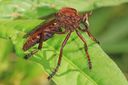
Diogmites basalis, commonly known as the New York killer, is a of robber fly in the Asilidae. Robber flies in this are known for their distinctive hanging , perching with forelegs raised and mid- and hind legs grasping vegetation. The species epithet "basalis" refers to the basal coloration pattern on the . This predatory fly is part of a diverse North American genus containing over 20 species, many of which are bee and mimics.
Pronunciation
How to pronounce Diogmites basalis: /daɪˈɒɡmɪtiːz bəˈseɪlɪs/
These audio files are automatically generated. While they are not always 100% accurate, they are a good starting point.
Identification
Distinguished from other Diogmites by the basal abdominal coloration pattern referenced in its specific epithet. The hanging posture—perching with forelegs raised and body suspended by mid- and hind legs—is characteristic of the . Separation from similar robber flies requires examination of abdominal pattern, leg spination, and male terminalia. D. basalis can be confused with other eastern North American Diogmites species, particularly D. angustipennis and D. platypterus; precise identification often requires reference to original description and comparison of .
Images
Appearance
Medium to large robber fly with characteristic Diogmites : elongated body, large , and strong spiny legs adapted for capturing prey in . The typically shows dark coloration with pale or yellowish basal markings, corresponding to the name "basalis." Like other members of the , it possesses a prominent mystax (bristles on the ) and a tapering abdomen. in size is common in the genus, with females generally larger than males.
Habitat
Open including fields, meadows, forest edges, and sandy areas where prey insects are abundant. Typical of Asilidae, requires elevated perches for hunting and bare or sandy ground for larval development.
Distribution
Eastern North America; confirmed records from Vermont and surrounding northeastern United States. The "New York killer" suggests primary association with New York State and adjacent regions.
Seasonality
active during summer months; typical period June through August in northern portions of range. Exact poorly documented.
Behavior
Exhibits the characteristic "hanging" of the Diogmites: perching with forelegs raised and mid- and hind legs grasping vegetation, body suspended beneath the perch. This posture is maintained while waiting for flying prey. Like other robber flies, it is an aerial that captures prey in using spiny legs.
Ecological Role
Aerial of other insects; contributes to regulation of and herbivore . As with other Asilidae, larvae are presumed to be predatory or in soil, though specific undocumented for this .
Human Relevance
"New York killer" reflects perception as a of bees, though actual impact on bee unquantified. Of minor interest to entomologists studying robber fly and . No significant economic importance documented.
Similar Taxa
- Diogmites angustipennisOverlapping eastern North American distribution and similar size; distinguished by wing shape and abdominal pattern
- Diogmites platypterusBroad-winged eastern with similar hanging ; requires examination of wing venation and body proportions for separation
- Other AsilidaeMany robber flies share general ; Diogmites distinguished by unique hanging posture and -specific leg proportions
More Details
Taxonomic history
Described by Francis Walker in 1851. The Diogmites was revised by Bromley in 1934, though modern molecular of the genus remains incomplete. The specific epithet "basalis" refers to the basal abdominal markings.
Etymology
name from Latin "basalis" meaning "at the base," referring to the pale markings at the base of the .