
Neomochtherus pallipes
(Meigen, 1820)
Devon red-legged robber fly
Neomochtherus pallipes, commonly known as the Devon red-legged robber fly, is a of robber fly in the Asilidae. The species is listed as Critically Endangered in the UK and is to or strongly associated with the Devon region of southwest England. It inhabits species-rich grasslands where it serves as a of other insects. Conservation efforts for this species are tied to management practices including cattle grazing that maintains structural diversity in grassland swards.
Pronunciation
How to pronounce Neomochtherus pallipes: /ˌniː.oʊˈmɑk.θər.əs ˈpæl.ɪ.piːz/
These audio files are automatically generated. While they are not always 100% accurate, they are a good starting point.
Identification
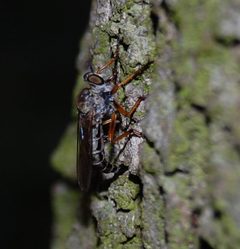
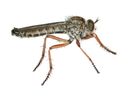
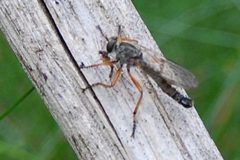
The red legs provide the primary distinguishing feature from other robber flies. In the UK context, it can be distinguished from the Hornet Robberfly (Asilus crabroniformis), another threatened grassland with which it shares , by its smaller size and leg coloration. Confirmation may require examination of genitalia or other microscopic features typical of Asilidae .
Images
Habitat
-rich grasslands in coastal and near-coastal areas. The species requires structurally diverse swards with a mosaic of taller and shorter vegetation, open patches, and created by cattle grazing. These microhabitats support the prey base and provide perching and hunting sites for the .
Distribution
Strongly associated with Devon in southwest England. GBIF records indicate presence in Belgium, Norway, and Sweden, though the UK appears restricted and potentially or near-endemic to the Devon region. The precise relationship between UK and continental European populations requires clarification.
Diet
Predatory, feeding on other insects captured in . Specific prey items have not been documented for this .
Behavior
Typical of robber flies, are aerial that perch on vegetation to scan for prey, then pursue and capture flying insects. The is associated with low mobility relative to its requirements, making natural of new sites unlikely without habitat connectivity.
Ecological Role
As a , contributes to of other grassland . Its presence indicates high-quality -rich grassland . The species has been used as a flagship for demonstrating the ecological value of cattle-grazed grasslands with structural diversity.
Human Relevance
Subject of conservation concern due to Critically Endangered status. Featured in advocacy for -rich grassland management under UK agri-environment schemes. The removal of cattle grazing supplements from the Sustainable Farming Initiative in 2026 was highlighted as threatening to this species specifically. Conservation to new sites has been considered given its limited range and specificity.
Similar Taxa
- Asilus crabroniformisHornet Robberfly shares similar grassland and is also threatened; distinguished by larger size and different leg coloration
- Other Neomochtherus speciesCongeneric may overlap in range; require detailed examination for separation
More Details
Conservation Status
Listed as Critically Endangered in the UK. Featured in Buglife's 'Life on the Edge' project working to restore 675ha of South Devon coast for conservation.
Agri-environment Scheme Significance
The was specifically cited by Buglife in criticism of the removal of GRH11 (Cattle grazing supplement) from the Sustainable Farming Initiative 2026, as cattle grazing creates the structural sward diversity this species requires.
Sources and further reading
- BugGuide
- Wikipedia
- GBIF taxonomy match
- iNaturalist taxon
- Catalogue of Life
- The Day That Dragonflies Sprang to Life | Bug Squad
- A step back for species-rich grasslands: why removing them from the Sustainable Farming Initiative matters for our endangered invertebrates - Buglife Blog - Buglife
- Secrets of the "Subnivium": Arthropod Community Thrives Beneath Winter Snowpack
- Conservation Translocations: It’s Not Just Beavers - Buglife Blog - Buglife
- In Search of Britain’s Endemics - Buglife Blog - Buglife