
Euborellia annulata
(Fabricius, 1793)
ring-legged earwig
Euborellia annulata is a predatory in the Anisolabididae, originally described by Fabricius in 1793. It has been extensively studied as a agent, particularly for lepidopteran pests in corn agroecosystems. The species exhibits five nymphal instars, in forceps size and predatory , and is known for its aggressive on soft-bodied insect larvae and .
Pronunciation
How to pronounce Euborellia annulata: /juːbɔːˈrɛliə ænˈjuːlætə/
These audio files are automatically generated. While they are not always 100% accurate, they are a good starting point.
Identification
Distinguished from similar predatory by combination of five nymphal instars (versus four in some ), annulated leg patterning, and association with tropical agricultural . Females identifiable by larger forceps and more aggressive predatory . Differs from co-occurring Nala lividipes in -level classification and subtle morphological features of the and forceps structure.
Images
Appearance
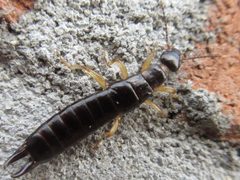
are medium-sized with characteristic forceps-like at the tip. Females possess larger, more robust forceps than males, which aids in prey capture. The exhibits ringed or annulated legs, referenced in its specific epithet. Nymphs progress through five instars, ranging from 4–13 mm in length depending on developmental stage. Wing pads develop progressively through nymphal instars, with full wings present in adults.
Habitat
Associated with tropical and subtropical agricultural , particularly corn (maize) fields. Laboratory rearing indicates preference for soil-sand substrates (1:1 ratio) with leaf litter or debris for shelter. Thrives at temperatures of 25–30°C and relative humidity 70–92%.
Distribution
Native to tropical and subtropical regions of Asia; recorded from Indonesia, Philippines, and broader East Asian corn-growing regions. Distribution records include Lakshadweep and West Bengal. Introduced or naturally occurring in agricultural areas where corn is cultivated.
Seasonality
Active year-round in tropical climates where temperatures remain favorable. Peak activity correlates with corn growing seasons and availability of lepidopteran prey. live 57–89 days under laboratory conditions.
Diet
specializing on soft-bodied insects. Prey includes and larvae of lepidopteran pests, particularly Asian corn borer (Ostrinia furnacalis) and fall armyworm (Spodoptera frugiperda). Laboratory studies document consumption of dog food as artificial diet, indicating opportunistic feeding .
Host Associations
- Ostrinia furnacalis - preyAsian corn borer; primary target for
- Spodoptera frugiperda - preyFall armyworm; pest of maize in Indonesia
- Zea mays - Corn; agricultural system where is active
Life Cycle
Hemimetabolous development with five nymphal instars. stage lasts 7–10 days. Nymphal development spans 39–46 days total, with individual instars showing progressive size increase from 4 mm to 13 mm. Fifth instar duration sexually dimorphic: 4–6 days (females), 2–3 days (males). emerge with fully developed wings and reproductive capability.
Behavior
that shelters in soil or plant debris during daylight hours. Uses forceps for prey capture, manipulation, and defense. Exhibits multiple mating with intervals of seconds to minutes between copulations. First mating duration highly variable (2–70 minutes). Females demonstrate greater predatory aggression than males, attributed to larger forceps . observed at high densities or under food scarcity.
Ecological Role
contributing to natural pest suppression in tropical agroecosystems. Functions as agent for lepidopteran pests in () programs. parameters include intrinsic growth rate (r) of 0.0772, net reproductive rate (R0) of 80.16, and limited growth rate (λ) of 1.17, indicating strong potential for population establishment and pest suppression.
Human Relevance
Actively deployed and studied as agent for corn borers and fall armyworm in East Asian and Southeast Asian agriculture. Incorporated into strategies to reduce reliance on chemical . Laboratory rearing protocols established using artificial diets, facilitating mass production for .
Similar Taxa
- Nala lividipesCo-occurring predatory in Philippine agricultural systems; distinguished by placement (Labiduridae vs. Anisolabididae) and subtle morphological differences in and forceps structure. Both studied concurrently as candidates.
- Euborellia plebejaCongeneric with similar and ecological role; may overlap in distribution and requires careful examination of genitalia and forceps structure for definitive identification.
More Details
Population Biology
Laboratory studies demonstrate sex ratio of 1.4 males:1.0 female. Natural mortality of averages 10.5%, with 89.5% hatching success. Females lay 86–166 eggs in five discrete oviposition events (9–45 eggs per batch). Pre-oviposition period lasts 6–13 days; oviposition period spans 32–59 days; post-oviposition period 21–51 days.
Predatory Efficacy
Two female achieve 66% on Spodoptera frugiperda larvae within 5 days, versus 52% for two males. Paired male-female combinations achieve 96–100% mortality of prey within 7–8 days, demonstrating potential for augmentative release strategies.
Sources and further reading
- BugGuide
- Wikipedia
- GBIF taxonomy match
- iNaturalist taxon
- NCBI Taxonomy
- Catalogue of Life
- Lepidoptera | Beetles In The Bush | Page 10
- Quiz Yourself: 2020 Entomology Games Questions
- May | 2010 | Beetles In The Bush | Page 2
- predator avoidance | Beetles In The Bush | Page 7
- warning coloration | Beetles In The Bush | Page 2
- BIOLOGY AND INTRINSIC GROWTH RATE OF EARWIG (Euborellia annulata)
- BIOLOGY AND INTRINSIC GROWTH RATE OF EARWIG (Euborellia annulata)
- Biology of Two Species of Predatory Earwigs Nala lividipes (Dufour) (Dermaptera: Labiduridae) and Euborellia (Euborellia) annulata (Fabricius) (Dermaptera: Carcinophoridae)
- Laboratory Evaluation of Predation Potency Euborellia Annulata (Dermaptera: Anisolabididae) on Larvae of Spodoptera Frugiperda (Lepidoptera: Noctuidae), a Pest of Maize Crops