
Phloeodes plicatus
(LeConte, 1859)
Wrinkled Ironclad Beetle
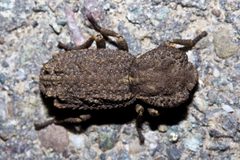
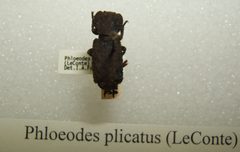
Phloeodes plicatus, commonly known as the Wrinkled Ironclad , is a flightless beetle in the Zopheridae. It is closely related to Phloeodes diabolicus, the diabolical ironclad beetle, and shares the remarkable structural durability characteristic of this . The has been reclassified under the genus Nosoderma in some taxonomic treatments.
Pronunciation
How to pronounce Phloeodes plicatus: /ˈfloʊ.i.oʊˌdiːz plɪˈkeɪtəs/
These audio files are automatically generated. While they are not always 100% accurate, they are a good starting point.
Identification
Distinguished from similar ironclad beetles by the wrinkled or plicate sculpturing of the . The Phloeodes (or Nosoderma) is separated from other zopherid genera by the combination of: flightless condition with elytra, extremely hard , and flattened body form. P. plicatus specifically differs from P. diabolicus in details of elytral sculpturing and geographic distribution. Identification to level requires examination of elytral and punctation patterns.
Images
Appearance
Dark-colored, heavily sclerotized with a flattened, low-profile body. The are densely layered and interlocking, creating a heavily armored, tank-like appearance. The exhibits pronounced sculpturing or wrinkling, consistent with the epithet 'plicatus'. are approximately 20-25 mm in length.
Habitat
Found under bark of dead or dying trees, particularly in forested and woodland areas. Associated with fungal growth on decaying wood. The flattened body form is an for living in tight spaces beneath bark.
Distribution
Recorded from North America. Specific range details are less documented than for the better-known P. diabolicus, but includes regions of western North America based on collection records.
Diet
Mycophagous: feeds on fungi growing under tree bark. Has been observed consuming mushrooms and fungal growth on decaying wood.
Host Associations
- Dead/dying trees - Lives under bark where fungal growth occurs
- Fungi - food sourcePrimary diet consists of fungal growth on decaying wood
Behavior
Flightless; moves by . When disturbed, plays dead (). The heavily armored provides passive defense against . Remains flat and low to the substrate, using cryptic coloration and flattened profile to avoid detection.
Ecological Role
Decomposer: contributes to nutrient cycling by consuming fungi associated with decaying wood. The association with dead wood and fungi places it in the saproxylic of forest .
Human Relevance
Of scientific interest due to the exceptional mechanical properties of its , which has inspired biomimetic research into durable materials and fastening systems. Not considered a pest .
Similar Taxa
- Phloeodes diabolicusExtremely similar in general appearance, , and defensive armor. Distinguished by differences in elytral sculpturing and or parapatric distribution. P. diabolicus is more extensively studied and has been the focus of mechanical testing research.
- Other Zopheridae genera (e.g., Zopherus)Share the heavily sclerotized 'ironclad' condition but differ in body form, elytral structure, and geographic range. Most Zopherus are not as extremely flattened.
More Details
Taxonomic Note
This has been transferred to the Nosoderma as Nosoderma plicatum by some authors, though Phloeodes plicatus remains widely used. The genus-level of ironclad beetles remains under revision.
Research Significance
While P. diabolicus has been the primary subject of mechanical testing (surviving 3400-pound compression), P. plicatus shares the same structural adaptations that make these beetles among the most crush- insects known. The elytral architecture involves interlocking layers, tight joints, and protein-enhanced .