
Phellopsis
J.L. LeConte, 1862
Species Guides
2- Phellopsis obcordata(Eastern Ironclad Beetle)
- Phellopsis porcata
Phellopsis is a of zopherid beetles established by J.L. LeConte in 1862. The genus contains approximately seven recognized distributed across North America and Asia. North American species P. obcordata and P. porcata are vicariant restricted to old growth forests of eastern and western North America, respectively. These species were historically confused until a 2008 revision clarified their distinct status. Asian species include P. amurensis (Russian Far East to Korea), P. suberea (Japan), P. chinense (west-central China), and P. yulongensis (Yunnan Province).
Pronunciation
How to pronounce Phellopsis: //ˈfɛl.ɒp.sɪs//
These audio files are automatically generated. While they are not always 100% accurate, they are a good starting point.
Identification
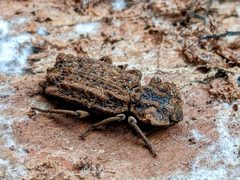
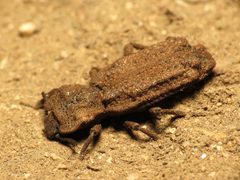
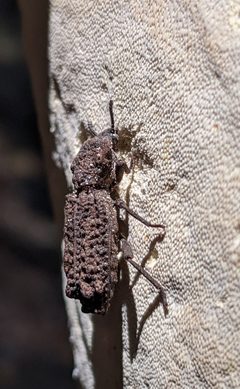
Phellopsis are small beetles, with P. obcordata measuring approximately 11–16 mm in length. Coloration ranges from reddish to brown. Species-level identification requires examination of subtle morphological differences; P. obcordata and P. porcata are nearly identical externally and were distinguished only through detailed revision work. A published key with illustrations is available for separating all recognized Phellopsis species.
Images
Habitat
Old growth forest . Phellopsis porcata has been observed under bark of dead trees in association with fungal growth on decaying wood.
Distribution
Eastern North America (P. obcordata), western North America (P. porcata), Russian Primorskii Krai extending to Korean peninsula (P. amurensis), Japan (P. suberea), west-central China (P. chinense), Yunnan Province of western China (P. yulongensis).
Similar Taxa
- Phellopsis obcordata / Phellopsis porcataThese sister are nearly identical in external and were historically confused until the 2008 revision; they are separated by geography (eastern vs. western North America) rather than obvious visual differences.