
Phellopsis porcata
(LeConte, 1853)
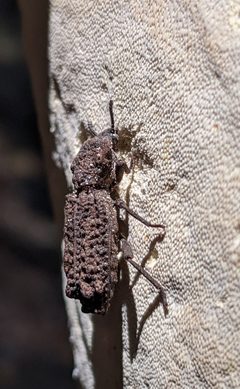
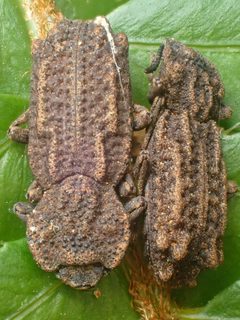
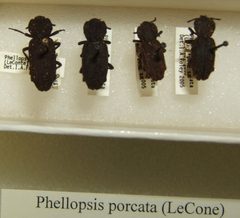
Phellopsis porcata is a flightless in the Zopheridae, to old-growth forests of western North America. It is a vicariant isolated from its eastern North American counterpart, P. obcordata. Both and larvae are mycophagous, specializing on polypore fungi growing on conifers and hardwoods. When disturbed, adults exhibit (death-feigning ).
Pronunciation
How to pronounce Phellopsis porcata: //fɛˈlɒp.sɪs pɔrˈkeɪ.tə//
These audio files are automatically generated. While they are not always 100% accurate, they are a good starting point.
Identification
Distinguished from the eastern vicariant P. obcordata by geographic separation; western North American distribution versus eastern. Separated from other Phellopsis by the revised circumscription in which P. robustula and P. montana are synonymized under P. porcata. Specific diagnostic morphological characters are not detailed in available sources.
Images
Habitat
Old-growth forest . Associated with standing and fallen trees bearing bracket fungi.
Distribution
Western North America: western United States and Canada. Documented from Alaska (US), Alberta, and British Columbia (Canada).
Diet
and larvae feed on fungi. Adults feed on the surface of fruiting bodies; larvae burrow into the substrate. Documented fungal include Piptoporus betulinus on birch (Betula papyrifera, B. lenta), Heterobasidion annosum on balsam fir (Abies balsamea), fungi on western hemlock (Tsuga heterophylla), and Lentinus .
Host Associations
- Piptoporus betulinus - food sourcePolypore fungus on birch
- Heterobasidion annosum - food sourceFungus on balsam fir
- Lentinus - food sourcePolypore
- Betula papyrifera - indirect; substrate for fungal Paper birch
- Betula lenta - indirect; substrate for fungal Black birch
- Abies balsamea - indirect; substrate for fungal Balsam fir
- Tsuga heterophylla - indirect; substrate for fungal Western hemlock
Life Cycle
Larval development occurs within fungal substrates. and larvae occupy the same general but utilize different feeding strategies: adults are surface feeders while larvae burrow internally.
Behavior
When threatened, employ (feigning death) to avoid .
Ecological Role
Mycophagous decomposer; contributes to nutrient cycling in old-growth forest through consumption of wood-decay fungi.
Similar Taxa
- Phellopsis obcordataVicariant sister in eastern North America; distribution is the primary distinguishing feature
- Phellopsis robustulaJunior synonym of P. porcata; historically described as distinct but now synonymized
- Phellopsis montanaJunior synonym of P. porcata; historically described as distinct but now synonymized
More Details
Taxonomic history
Phellopsis robustula Casey and P. montana Casey were previously recognized as distinct but were synonymized under P. porcata in the 2007 revision of the .
Biogeographic significance
The P. porcata/P. obcordata pair represents a classic eastern-western vicariance pattern in North American forest fauna, likely resulting from Pleistocene glacial refugia.