
Lasconotus vegrandis
Horn, 1885
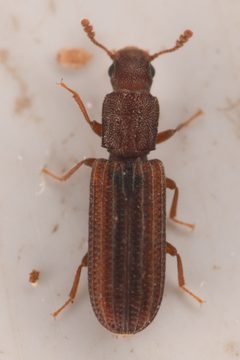
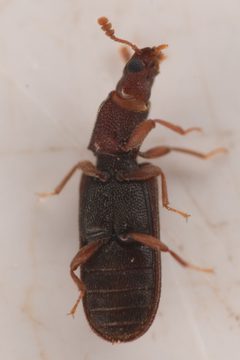
Lasconotus vegrandis is a of cylindrical bark beetle in the Zopheridae, first described by George Henry Horn in 1885. It belongs to a characterized by compact, cylindrical body forms adapted for life under bark. The species has been documented in western North America, with records from British Columbia. Like other members of its family, it is presumed to inhabit dead or decaying wood, though specific ecological details remain poorly documented.
Pronunciation
How to pronounce Lasconotus vegrandis: /læsˈkoʊnətəs vɛˈɡrændɪs/
These audio files are automatically generated. While they are not always 100% accurate, they are a good starting point.
Identification
Members of Lasconotus can be distinguished from other zopherid by their strongly cylindrical body form, with that are parallel-sided and often possess distinct surface sculpturing. L. vegrandis is among the smaller in the genus; the specific epithet "vegrandis" (Latin: "somewhat small") refers to its reduced size relative to . Positive identification to species level requires examination of male genitalia or comparison with , as external morphological differences between Lasconotus species are subtle.
Images
Habitat
Inferred from -level characteristics and : inhabits subcortical spaces of dead or dying trees and woody debris. Specific associations for L. vegrandis have not been documented.
Distribution
North America; confirmed records from British Columbia, Canada. The full extent of its range within North America is not well established.
Similar Taxa
- Lasconotus subcostulatusOverlapping distribution in western North America; similar cylindrical form but generally larger and with more pronounced elytral costulae (ridges). L. vegrandis is distinguished by its smaller size and relatively smoother elytral surface.
- Other Zopheridae (e.g., Pycnomerus, Orthocis)These share the cylindrical bark beetle habitus but differ in antennal structure, tarsal formula, and body proportions. Lasconotus have distinctly clubbed with compact, rounded clubs.
More Details
Taxonomic history
Described by George Henry Horn in 1885 in his 'Coleoptera of Baja California.' The has received limited taxonomic attention since its original description, and no modern revisions of the Lasconotus have comprehensively treated L. vegrandis.
Data deficiency
With only 3 observations in iNaturalist and minimal literature coverage, this exemplifies the information gap for many inconspicuous . Basic biological parameters—including associations, larval development, and —remain entirely unknown.