
Colydium lineola
Say, 1826
Lined Cylindrical Bark Beetle
Colydium lineola is a of cylindrical bark beetle in the Zopheridae, first described by Thomas Say in 1826. The species is known from North America, with records from British Columbia to Ontario in Canada. As a member of the cylindrical bark beetles, it inhabits forested environments where it likely feeds on fungi associated with dead wood.
Pronunciation
How to pronounce Colydium lineola: //kəˈlɪdiəm lɪniˈoʊlə//
These audio files are automatically generated. While they are not always 100% accurate, they are a good starting point.
Identification
Colydium lineola can be distinguished from other Colydium by the fine linear markings suggested by its species name. Separation from other cylindrical bark beetles in the Zopheridae requires examination of antennal structure, pronotal shape, and elytral sculpturing. The Colydium is characterized by features of the and the form of the prosternal process. Definitive identification to species level typically requires examination of genitalic characters or detailed comparison with .
Images
Appearance
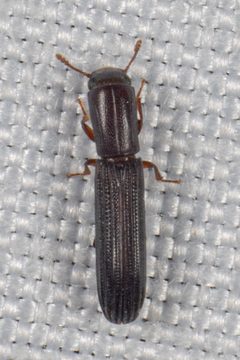
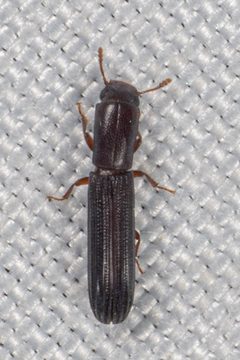
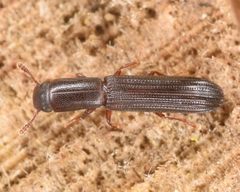
As a cylindrical bark beetle, the body is elongated and cylindrical in form. The specific epithet 'lineola' suggests the presence of fine linear markings on the or body. Members of the Colydium typically exhibit a somewhat flattened, parallel-sided body shape with that may be clubbed or gradually thickened toward the tip. The body is generally dark in coloration.
Habitat
Forested environments; associated with dead wood and bark where cylindrical bark beetles typically occur. The likely inhabits mature forests with sufficient woody debris to support fungal growth.
Distribution
North America. Documented from British Columbia and Ontario in Canada. The full range within North America is not comprehensively mapped, but the occurs across at least the northern and western portions of the continent.
Ecological Role
As a member of the cylindrical bark beetles ( Zopheridae), C. lineola likely functions as a fungivore in forest , feeding on fungi that colonize dead wood and bark. This feeding habit contributes to nutrient cycling and wood decomposition processes in forest .
Similar Taxa
- Other Colydium speciesShare the same and general cylindrical body form; require detailed examination of elytral markings and structural characters for separation
- Other Zopheridae (cylindrical bark beetles)Similar and body form; distinguished by antennal structure, prosternal , and other -level characters
More Details
Taxonomic History
The was first described by Thomas Say in 1826, an early American entomologist who made foundational contributions to the study of North American insects. The specific epithet 'lineola' is derived from Latin, meaning 'small line' or 'stripe', referring to the linear markings characteristic of this species.
Family Classification
Zopheridae, the containing Colydium lineola, has undergone taxonomic revision. These beetles were previously often treated as a (Colydiinae) within the family or Tenebrionidae, but are now recognized as a distinct family. This reclassification reflects improved understanding of relationships among the 'cucujoid' lineages.
Sources and further reading
- BugGuide
- Wikipedia
- GBIF taxonomy match
- iNaturalist taxon
- NCBI Taxonomy
- Stalk-boring insect pests - AgriLife Extension Entomology
- Bug Eric: Spider Sunday: Striped Lynx Spider
- Bug Eric: Wasp Wednesday: Anacrabro ocellatus
- Sulfoxaflor Found to Be Less Harmful to Beneficial Predators of Soybean Aphids
- Glyphosate and Acetamiprid Have Relatively Low Toxicity for Honey Bees
- Bug Eric: August 2011