
Zophobas atratus
(Fabricius, 1775)
superworm, kingworm, barley worm, morio worm, giant mealworm beetle
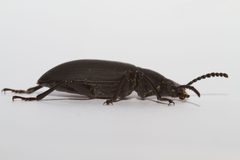
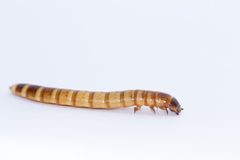
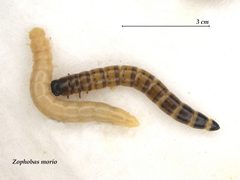
Zophobas atratus is a darkling beetle (Tenebrionidae) whose larvae, known as superworms, are widely used as feed for captive reptiles, amphibians, birds, and fish. The is notable for its larger size compared to the yellow mealworm (Tenebrio molitor), with larvae reaching 50–60 mm in length. measure up to 57 mm. The species has gained attention for its ability to biodegrade polystyrene plastics through mechanical shredding and bacterial gut activity. It is native to tropical regions of Central and South America but has been introduced globally through the pet trade. The name Zophobas morio is a junior synonym.
Pronunciation
How to pronounce Zophobas atratus: //ˈzoʊfoʊbæs əˈtreɪtəs//
These audio files are automatically generated. While they are not always 100% accurate, they are a good starting point.
Identification
Larvae are distinguished from Tenebrio molitor by their substantially larger size (50–60 mm vs. 25–35 mm), dark terminal abdominal segments ( larvae have uniformly colored ends), and softer . are larger than T. molitor adults (up to 57 mm vs. 12–25 mm) and more robust. Larvae do not enter hibernation in response to cold, unlike mealworms. is delayed by crowding and high food availability; isolated larvae pupate within 7–10 days.
Images
Habitat
Native to tropical regions. In captivity, thrives in warm temperatures; does not hibernate. Larvae are commonly reared in high- cultures with abundant food, which delays .
Distribution
Native to tropical regions of Central and South America. Introduced and established globally through the pet trade and commercial rearing, including Europe, Asia, and North America. Recorded as a new introduction to Ukraine.
Diet
Larvae consume oatmeal, wheat bran, cornmeal, and other grain-based materials in culture. In experimental settings, larvae consume expanded polystyrene (EPS), extruded polystyrene (XPS), and other plastics including polypropylene, high- polyethylene, and low-density polyethylene. Gut bacteria including Kluyvera sp., Klebsiella sp., and Enterobacter sp. are associated with polystyrene degradation.
Life Cycle
Complete . stage: 7 days. Larval stage: up to 151 days, with 12 instars recorded in laboratory culture; pre-pupal period 6–22 days. Pupal stage: 8–21 days. Total development from egg to : 169–181 days. Adults live up to 206 days. Maturation of eggs in females after copulation: 10–11 days. is facultatively delayed by larval crowding and abundant food; isolation induces pupation within 7–10 days.
Behavior
Larvae exhibit -dependent plasticity in development: crowding with plentiful food delays , while isolation triggers pupation. Larvae are capable of mechanical shredding of polystyrene foam through chewing, followed by bacterial depolymerization in the gut. Larvae can survive 1–2 weeks without food. possess a pungent chemical defense released when provoked. Larvae may bite when threatened by handling.
Ecological Role
In native range, ecological role is poorly documented. In commercial and laboratory contexts, larvae function as decomposers of organic matter and, experimentally, as agents of plastic biodegradation. Larvae fragment polystyrene into microplastics through feeding activity, potentially contributing to soil plastic dynamics.
Human Relevance
Primary use is as live feed for captive reptiles, amphibians, fish, birds, and other . Preferred over in some cases due to softer and higher digestibility. Nutritional profile: approximately 46.8% protein, 43.6% lipids. Calcium supplementation recommended if used as staple food. Used as a for rearing beetles such as Dastarcus longulus. Investigated for human consumption () in Mexico and Thailand, and as a protein source for aquaculture and poultry. Potential applications in plastic waste management and as a source of antimicrobial . Extracts investigated for neuroprotective properties in experimental models.
Similar Taxa
- Tenebrio molitorYellow mealworm is smaller (larvae 25–35 mm, 12–25 mm), has uniformly colored larval terminal segments, harder larval , and enters hibernation in cold conditions. Treated with to produce 'giant ' that do not pupate, but these are chemically induced, not a natural size difference.
- Tenebrio obscurusLesser mealworm is smaller and darker than T. molitor; larvae lack the dark terminal segments of Z. atratus.
Misconceptions
The 'giant ' is sometimes applied to -treated Tenebrio molitor larvae, which are not naturally large but chemically prevented from pupating. Zophobas atratus achieves large size naturally without hormonal treatment. The name Zophobas morio is still widely used in scientific literature but is a junior synonym; Z. atratus (1775) has priority over Z. morio (1777).
Sources and further reading
- BugGuide
- Wikipedia
- GBIF taxonomy match
- iNaturalist taxon
- NCBI Taxonomy
- Bug Eric: Caught on Video: Prionyx atratus
- Superworms: The Bigger, Brawnier, Hungrier Cousins of Yellow Mealworms
- Tabanidae | Beetles In The Bush
- Study Examines Insects' Role in Plastic Pollution
- Brazil Bugs #4 – Mais dos percevejos | Beetles In The Bush
- Crowding, Maternal Age, Age at Pupation, and Life History of Zophobas atratus (Coleoptera: Tenebrionidae)
- Laju Degradasi Beberapa Jenis Plastik Menggunakan Ulat Hongkong (Tenebrio molitor L.) dan Ulat Jerman (Zophobas atratus F.)
- Zophobas atratus (Fabricius, 1775) – new genus and species of darkling beetles (Coleoptera, Tenebrionidae) for the fauna of Ukraine
- A Third Type of Defensive Behavior in the Tenebrionid BeetleZophobas atratusPupae
- Development of optimized artificial diets for enhanced growth of Zophobas atratus larvae
- A method for rearing larvae of the parasitoid beetle Dastarcus longulus (Coleoptera: Bothrideridae) using Zophobas atratus (Coleoptera: Tenebrionidae) pupae
- The synergistic extract of Zophobas atratus and Tenebrio molitor regulates neuroplasticity and oxidative stress in a scopolamine-induced cognitive impairment model
- Biodegradation of Expanded and Extruded Polystyrene with Different Diets by Using Zophobas atratus Larvae (Coleoptera: Tenebrionidae)