
Centronopus opacus
LeConte, 1859
Centronopus opacus is a of darkling beetle in the Tenebrionidae, first described by John Lawrence LeConte in 1859. It is to North America, with records spanning the United States and potentially southern Canada. Like other tenebrionids, it is a ground-dwelling adapted to arid and semi-arid environments. The Centronopus is small and poorly studied, with limited published information on the and of its constituent species.
Pronunciation
How to pronounce Centronopus opacus: //sɛn.trəˈnoʊ.pəs oʊˈpeɪ.kəs//
These audio files are automatically generated. While they are not always 100% accurate, they are a good starting point.
Identification
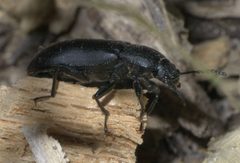
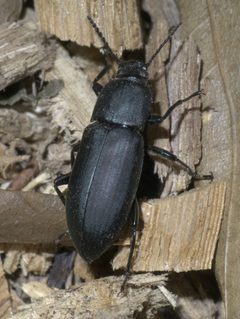
Centronopus opacus can be distinguished from other darkling beetles by its placement in the Centronopus, which is characterized by specific antennal and tarsal structures. Within Tenebrionidae, it lacks the strongly explanate (flattened and expanded) elytral margins seen in genera such as Embaphion. Definitive identification to level requires examination of male genitalia and comparison with type material. The species epithet 'opacus' refers to the dull, non-reflective typical of this .
Images
Habitat
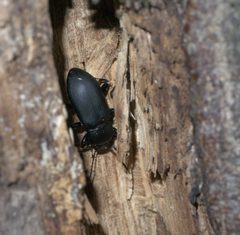
Arid and semi-arid environments including desert scrub, grasslands, and open woodlands. Associated with sandy or rocky substrates where it can be found under debris, stones, or within soil cracks during daylight hours.
Distribution
North America. Specific records include the southwestern and south-central United States. The exact northern and eastern limits of its range remain poorly documented.
Similar Taxa
- Eleodes spp.Eleodes is the most -rich and commonly encountered of darkling beetles in North American arid lands. Eleodes species share the ground-dwelling habit and general body form of Centronopus opacus but typically exhibit the distinctive 'headstand' defensive posture and have different antennal structure.
- Embaphion muricatumThis co-occurring tenebrionid shares similar preferences but is immediately distinguishable by its dramatically explanate (flattened and expanded) that form a broad, flat disc over the , unlike the more cylindrical body of Centronopus opacus.
- Eusattus spp.These small darkling beetles overlap in distribution and but are generally smaller, more convex in body form, and possess different tarsal and antennal characteristics.