
Iphthiminus serratus
(Mannerheim, 1843)
Serrated Darkling Beetle
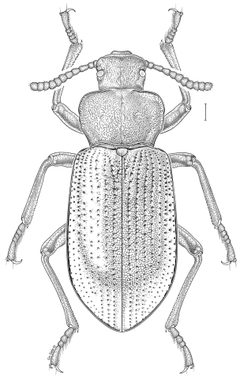
Iphthiminus serratus is a darkling beetle in the Tenebrioninae, distinguished from by its moderately wrinkled prothorax with serrated lateral edges. Former I. sublaevis and I. salebrosus have been synonymized under this name due to gradual geographic variation. The is strongly associated with rotting coniferous wood, particularly pine, across western North America.
Pronunciation
How to pronounce Iphthiminus serratus: /ɪfˈθɪmɪnəs sɛˈreɪtəs/
These audio files are automatically generated. While they are not always 100% accurate, they are a good starting point.
Identification
Distinguished from other Iphthiminus by the moderately wrinkled prothorax with moderate serrations along the lateral edges; other exhibit more pronounced or reduced surface sculpturing.
Images
Habitat
Associated with rotting coniferous logs, especially pine wood; occurs in forested environments where decaying wood is present.
Distribution
Western North America: California, Idaho, Nebraska, Nevada, New Mexico, Oregon, Washington, Wyoming, British Columbia, and Alberta.
Diet
In captivity, has been observed consuming chick feed and rotting wood; field diet inferred from association with decaying coniferous material.
Ecological Role
Contributes to decomposition of coniferous wood in forest .
Similar Taxa
- Iphthiminus sublaevisFormerly considered a ; synonymized due to gradual geographic variation in prothorax sculpturing
- Iphthiminus salebrosusFormerly considered a ; synonymized due to gradual geographic variation in prothorax sculpturing