
Edrotes ventricosus
LeConte, 1851
hairy robot beetle, desert hairy robot beetle
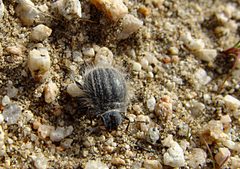
Edrotes ventricosus is a small darkling beetle native to southwestern North American deserts. are distinctive for their rounded, compact body shape and dense covering of hairs. The is herbivorous and has been observed feeding on several plant species including saltgrass and cheat grass. It is active primarily from early spring through late winter, with year-round activity in the southern portion of its range. The has become popular in the pet trade due to its manageable care requirements and appealing appearance.
Pronunciation
How to pronounce Edrotes ventricosus: /ɛˈdroʊtiːz vɛntrɪˈkoʊsəs/
These audio files are automatically generated. While they are not always 100% accurate, they are a good starting point.
Identification
The combination of small size (under 10 mm), highly rounded body shape, black coloration, and dense hairs distinguishes this from most other darkling beetles in its range. The 'robot-like' rounded profile and fuzzy appearance are distinctive field marks. Similar darkling beetles in the region tend to be more elongate or lack the dense hair covering.
Images
Habitat
Desert environments, specifically arid and semi-arid regions of the southwestern United States and northwestern Mexico. Occupies open sandy or rocky desert terrain.
Distribution
Southwestern United States (California, Nevada, Arizona) and northwestern Mexico (Baja California, Sonora).
Seasonality
Active from early spring through late winter. in the southern portion of the range are active year-round. may emerge on warmer days during winter to feed.
Diet
Herbivorous. Known to feed on saltgrass (Distichlis spicata), cheat grass (Bromus tectorum), saltwort (Salsola spp.), and wild onion (Allium spp.).
Life Cycle
Details of stages and development not documented in available sources.
Behavior
may emerge during winter on warmer days to feed. Otherwise active during cooler periods of the year, avoiding extreme summer heat.
Ecological Role
Herbivore in desert . Role in nutrient cycling and not documented.
Human Relevance
Kept as pets due to ease of care and appealing 'cute' appearance from small rounded body and fuzzy texture.
Similar Taxa
- Other Edrotes speciesShare -level traits of rounded body form, but specific identification requires examination of subtle morphological differences not covered in general sources.
- General TenebrionidaeMany darkling beetles in desert are elongate or flattened; the strongly rounded, hairy body of E. ventricosus is distinctive.
More Details
Colorado record
A specimen was photographed in Prowers County, Colorado in May 2017, representing a notable range extension from the core southwestern distribution. This appears to be an isolated record rather than established .