
Hymenorus
comb-clawed beetle
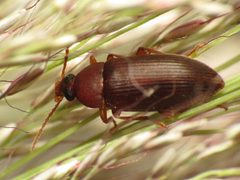
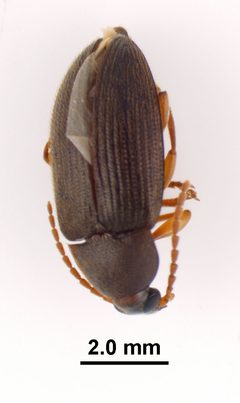
Hymenorus is a of comb-clawed beetles in the Tenebrionidae, Alleculinae. These beetles were formerly classified in their own family, Alleculidae, but were recently reclassified as part of Tenebrionidae. They represent one of several groups of beetles that complicate the traditional 'darkling beetle' stereotype, as they do not closely resemble the more familiar Eleodes-type darkling beetles.
Pronunciation
How to pronounce Hymenorus: /haɪˈmɛn.ə.rəs spʌn kæˈlɪf/
These audio files are automatically generated. While they are not always 100% accurate, they are a good starting point.
Identification
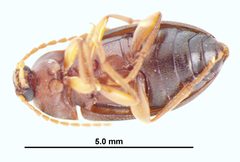
Hymenorus can be distinguished from 'classic' darkling beetles (such as Eleodes) by their overall , which does not match the typical darkling beetle form. Unlike many ground beetles (Carabidae), they possess bead-like segments rather than filament-like antennae. Their are concealed beneath the , not exposed and directed forward as in predatory ground beetles. As members of the Alleculinae, they have comb-like claws on their , a characteristic feature of this .
Images
Similar Taxa
- Eleodes (darkling beetles)Classic darkling beetles with which Hymenorus is often confused; Hymenorus lacks the robust, rounded body form and defensive -standing of Eleodes
- Carabidae (ground beetles)Predatory beetles with exposed and filament-like that can be distinguished from Hymenorus by these characters
- Lagriinae (long-jointed beetles)Another former now placed in Tenebrionidae that also lacks classic darkling beetle appearance; distinguished by elongated body form and long segments
More Details
Taxonomic history
The Alleculinae (comb-clawed beetles), including Hymenorus, were formerly treated as a separate Alleculidae before being subsumed into Tenebrionidae. This reclassification explains why some Hymenorus do not resemble typical darkling beetles.