
Hymenorus obesus
Casey, 1891
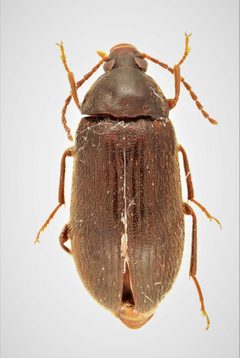
Hymenorus obesus is a small comb-clawed beetle in the Tenebrionidae, Alleculinae. It was described by Thomas L. Casey in 1891 based on specimens from North America. The belongs to a group formerly classified as the separate family Alleculidae, now treated as a subfamily within Tenebrionidae. Members of this are typically small, soft-bodied beetles with comb-like claws on their . Available records indicate this species occurs in eastern and central Canada.
Pronunciation
How to pronounce Hymenorus obesus: /ˌhaɪməˈnoʊrəs oʊˈbisəs/
These audio files are automatically generated. While they are not always 100% accurate, they are a good starting point.
Identification
Hymenorus obesus can be distinguished from ground beetles (Carabidae) by its bead-like segments and concealed beneath the , versus the thread-like antennae and exposed forward-directed jaws of carabids. Within Alleculinae, identification requires examination of genitalia and other fine structural details; the specific epithet 'obesus' (meaning fat or stout) may refer to body proportions relative to . The Hymenorus contains multiple similar species, and dissection or expert examination is typically required for definitive identification.
Images
Distribution
Recorded from Manitoba, New Brunswick, Nova Scotia, Ontario, and Quebec, Canada. The distribution appears centered in eastern and central Canada, though this may reflect collection rather than the true range limits.
Similar Taxa
- Hymenorus other speciesMultiple occur in the same geographic region and are externally similar; genitalic examination typically required for separation
- Ground beetles (Carabidae)Superficially similar dark, elongate beetles, but distinguished by thread-like , exposed , and rapid running
- Other Alleculinae (comb-clawed beetles)Share the pectinate tarsal claws and general body form; require detailed structural examination for -level identification
More Details
Taxonomic history
The Alleculinae was formerly treated as the separate Alleculidae. Hymenorus obesus was described by Thomas L. Casey, a prolific American entomologist who named thousands of in the late 19th and early 20th centuries. The species description appeared in Casey's 1891 work on North American Coleoptera.
Data limitations
This is poorly represented in public databases and literature. The seven iNaturalist observations and limited GBIF records suggest it is either genuinely uncommon, undercollected, or difficult to identify from photographs. No published biological studies specifically addressing this species were located.