
Pyrota mutata
(Gemm.)
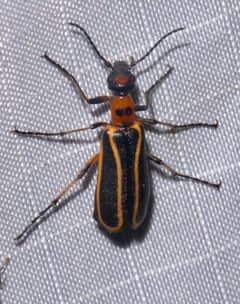
Pyrota mutata is a blister beetle in the Meloidae, tribe Pyrotini. The was historically known as Pyrota germari, but this synonymy has been rejected and P. mutata is now the accepted name. As a member of the blister beetle family, it possesses the characteristic chemical defense system based on . The Pyrota is distributed in the Americas, with species recorded from both North and South America.
Pronunciation
How to pronounce Pyrota mutata: /paɪˈroʊtə mjuˈtɑtə/
These audio files are automatically generated. While they are not always 100% accurate, they are a good starting point.
Identification
in the Pyrota are recognized by their elongated body form, soft , and typically aposematic coloration patterns. Pyrota mutata specifically may be distinguished from by subtle differences in color pattern and body proportions, though precise diagnostic features require examination of type material and comparison with related species such as P. bilineata and P. palpalis. The historical confusion with P. germari suggests close morphological similarity to that .
Images
Distribution
The Pyrota occurs in the Americas. Museum holdings indicate specimens of P. mutata are present in North American collections, though specific geographic origin of voucher specimens is not detailed in available sources. The tribe Pyrotini has representatives across the New World, with concentrated in western North America and extending into Central and South America.
Ecological Role
As a blister beetle, P. mutata likely participates in the chemical defense-based ecological interactions characteristic of Meloidae. The Pyrota includes that form mating on flowers, where feed on pollen and nectar. Larval stages of related species are typically or parasitic on ground-nesting bees, though specific relationships for P. mutata remain undocumented.
Human Relevance
Blister beetles in the Pyrota are of minor direct economic significance, though the Meloidae as a whole contains that can cause livestock poisoning when beetles are accidentally consumed in hay. The historical taxonomic confusion between P. mutata and P. germari illustrates challenges in meloid .
Similar Taxa
- Pyrota bilineataShares the and general body plan, with similar elongated form and soft . P. bilineata is distinguished by two black pronotal spots and distinctive black and white longitudinal elytral stripes, and has been well-documented forming large mating on yellow rabbitbrush (Chrysothamnus viscidiflorus) in the western United States.
- Pyrota palpalisAnother congeneric with superficially similar appearance, sometimes referred to as the 'Charlie Brown Blister Beetle' due to its color pattern. P. palpalis has been recorded in western North America and may overlap in distribution with P. mutata.
- Pyrota germariThe former name for this ; represents the same under outdated . The synonymy has been formally rejected in modern treatments.
More Details
Nomenclatural History
The was originally described under the name Pyrota germari, but this name has been synonymized and rejected. Pyrota mutata (Gemm.) is now the accepted valid name. The original description authority is abbreviated as Gemm., referring to Gemminger. The Entomology Research Museum at the University of California, Riverside holds 30 specimens of this species as of April 2010.
Generic Characteristics
Pyrota is a moderately diverse within the tribe Pyrotini, containing approximately 30 described . The genus is characterized by with soft, flexible , elongated bodies, and typically contrasting color patterns of orange, black, and white. Species in this genus exhibit substantial intraspecific size variation, with some individuals showing extreme size differences between males and females during mating.