
Lytta magister
Horn, 1870
desert blister beetle, master blister beetle
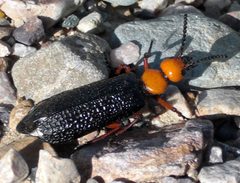
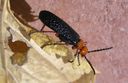
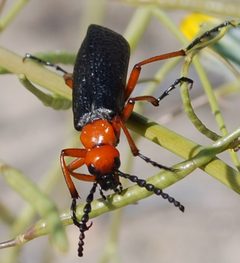
Lytta magister is a large, conspicuous blister beetle native to southwestern North America. are readily identified by their striking aposematic coloration: bright red , legs, and prothorax contrasting sharply with black . The is strongly associated with desert environments, where adults emerge in spring and are frequently observed in on flowers. Larvae are predatory or parasitic on ground-nesting bees, a common pattern in the Meloidae. The species possesses chemical defenses typical of the family, including cantharidins that can cause blistering upon contact with skin.
Pronunciation
How to pronounce Lytta magister: //ˈlɪtə məˈdʒɪstər//
These audio files are automatically generated. While they are not always 100% accurate, they are a good starting point.
Identification
Distinguished from other Lytta and sympatric blister beetles by the unique combination of bright red , legs, and prothorax with uniformly black . Body length ranges from 16 to 33 mm, making it among the larger members of the . The pronotum lacks the vittae or sculpturing seen in some related species such as Lytta vulnerata. Similar in general color pattern to some Epicauta species, but separated by body form and antennal structure.
Images
Habitat
Arid and semi-arid desert environments, particularly the Mojave and Colorado Deserts. are frequently encountered on flowering plants in open, sandy or rocky desert terrain.
Distribution
Southwestern North America, including the Mojave and Colorado Deserts of California, Nevada, Arizona, and adjacent regions. Records extend into California beyond the core desert regions, with specimens collected from coastal scrub .
Seasonality
are active primarily in spring, with peak abundance during this period. Observations indicate strong seasonality tied to desert flowering and temperature conditions.
Diet
feed on flowers and leaves of desert plants, with documented associations including brittlebush (Encelia farinosa) and coyote brush (Baccharis pilularis). Larvae are insectivorous, attacking nests of ground-nesting bees; they consume both the bees and their pollen provisions.
Life Cycle
Females deposit in holes excavated in desert soil. Larvae are triunguliniform initially, then develop through several instars. Larval involves locating and entering nests, where they function as facultative or . They can complete development on pollen provisions alone, making them food rather than obligatory parasitoids.
Behavior
are frequently observed in large or swarms during spring activity periods. Females engage in extended soil excavation to prepare deposition sites, sometimes spending more than 30 minutes enlarging burrows. Adults are capable of biting if handled, though they are not venomous. Defensive releases cantharidins from leg joints when disturbed.
Ecological Role
Larvae function as significant or of ground-nesting bees, potentially impacting local . serve as while feeding on desert flowers, and their aposematic coloration indicates a role in predator education within desert .
Human Relevance
content makes this a blistering hazard if crushed against skin; the chemical causes painful, slow-healing blisters. Historically related to the "Spanish fly" tradition of medicinal and aphrodisiac use, though L. magister itself is not the source species (Lytta vesicatoria). are conspicuous and frequently encountered by desert hikers and field biologists.
Similar Taxa
- Lytta vulnerataOverlaps in distribution and general body form, but distinguished by black and orange coloration rather than red and black, and by elytral sculpturing and pronotal markings in most .
- Epicauta speciesSome Epicauta share black and red warning coloration, but differ in antennal structure, body proportions, and elytral texture; Epicauta are generally smaller and more gracile.
Sources and further reading
- BugGuide
- Wikipedia
- GBIF taxonomy match
- iNaturalist taxon
- NCBI Taxonomy
- Meloidae Holdings | Entomology Research Museum
- Learn About Monarchs at Western Monarch Summit in San Luis Obispo | Bug Squad
- blister beetles | Beetles In The Bush | Page 3
- Blistering beetles - Meloe spp. — Bug of the Week
- Bug of the Week
- Ground nesting bees beware of blister beetles - Meloe spp. — Bug of the Week
- New Host Record For Adult Lytta magister Horn (Coleoptera: Meloidae) from California, USA
- New Host Records for AdultLytta magisterHorn (Coleoptera: Meloidae) from California, USA