
Eupompha schwarzi
Wellman, 1909
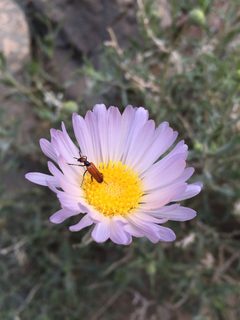
Eupompha schwarzi is a of blister beetle in the Meloidae, first described by Wellman in 1909. It belongs to the tribe Eupomphini, a group of meloid beetles primarily associated with creosote bush (Larrea tridentata) and other desert vegetation in arid regions of western North America. The Eupompha is characterized by aposematic coloration, often with metallic green or blue hues combined with orange or red markings. Like other blister beetles, E. schwarzi possesses , a defensive compound that causes skin blistering.
Pronunciation
How to pronounce Eupompha schwarzi: /juːˈpɒmfə ˈʃvwɑrtsi/
These audio files are automatically generated. While they are not always 100% accurate, they are a good starting point.
Images
Habitat
Arid and semi-arid regions of western North America, particularly associated with creosote bush scrub and desert wash . The has been documented in areas with Larrea tridentata (creosote bush) vegetation.
Distribution
North America, specifically recorded from the southwestern United States including Texas, New Mexico, and Arizona, with range extending into adjacent regions of northern Mexico.
Host Associations
- Larrea tridentata - associatedcreosote bush; common plant for Eupompha
Similar Taxa
- Eupompha fissicepscongeneric with similar coloration and preferences, also associated with creosote bush; distinguished by specific elytral and pronotal markings
- Eupompha eleganscongeneric with overlapping distribution; distinguished by color pattern and body proportions
More Details
Museum Holdings
According to the Entomology Research Museum at UC Riverside (J. Pinto collection, 2010), there are 147 specimens of Eupompha schwarzi in the collection, indicating it is relatively well-represented in institutional collections compared to some .
Taxonomic Authority
The was described by Wellman in 1909, with the specific epithet 'schwarzi' likely honoring an entomologist or collector, a common practice in early 20th century .
Sources and further reading
- BugGuide
- Wikipedia
- GBIF taxonomy match
- iNaturalist taxon
- NCBI Taxonomy
- Meloidae Holdings | Entomology Research Museum
- Another look at North America’s most beautiful longhorned beetle | Beetles In The Bush
- Bug Eric: Webspinners
- How to collect larvae of Amblycheila cylindriformis | Beetles In The Bush
- Belostomatidae | Beetles In The Bush