
Cysteodemus armatus
LeConte, 1851
inflated beetle, inflated blister beetle
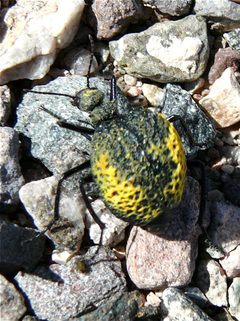
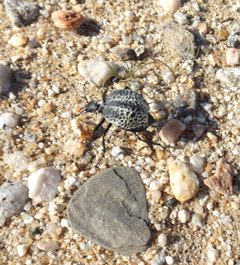
Cysteodemus armatus is a flightless blister beetle in the Meloidae, distinguished by its dramatically inflated that form a rounded, dome-like covering. The occurs in arid and semi-arid regions of southwestern North America and Central America. Its wing covers render it incapable of , an unusual trait among beetles. The 's distinctive appearance and defensive chemistry align with typical meloid characteristics, though specific ecological details remain poorly documented.
Pronunciation
How to pronounce Cysteodemus armatus: /sɪs.teɪ.oʊˈdiː.məs ɑrˈmɑː.təs/
These audio files are automatically generated. While they are not always 100% accurate, they are a good starting point.
Identification
The combination of , inflated forming a dome-like covering and the black-with-white-spots coloration is diagnostic. No other North American meloid exhibits this extreme elytral inflation. The flightless condition and rounded body profile distinguish it from all similar-sized dark beetles in its range. Elytral fusion is visible as a continuous longitudinal without separation.
Images
Habitat
Arid and semi-arid environments including desert scrub, grasslands, and open dry . Specific microhabitat preferences are not well documented, but the is associated with warm, dry conditions typical of its geographic range.
Distribution
Southwestern United States (including California, Arizona, New Mexico, Texas) and Mexico, extending into Central America. Records indicate presence across the desert and dryland regions of western North America southward through the Mexican plateau and Central American dry forests.
Seasonality
activity patterns are not well documented. Like many desert-adapted meloids, activity likely coincides with warm seasons and seasonal rainfall patterns, though specific timing remains unconfirmed.
Behavior
The flightless condition, resulting from , restricts movement to . This likely influences foraging range and capacity compared to winged relatives. Specific behavioral observations are sparse.
Ecological Role
As a blister beetle, it likely possesses defensive chemistry typical of the , potentially deterring . Its ecological interactions are otherwise poorly known.
Human Relevance
Like other meloids, may contain and should be handled with caution. Not a significant agricultural pest. The distinctive appearance makes it a notable find for naturalists and collectors.
Similar Taxa
- Cysteodemus wislizeniThe only congeneric ; also has inflated but differs in distribution and subtle morphological details of the elytral contour and punctation
- Epicauta spp.Common North American blister beetles with typical elongate body form and functional wings; lack the inflated, and dome-shaped profile
- Eupompha spp.Related eupomphine meloids with more conventional body shapes and fully developed wings; not inflated or
More Details
Etymology
The specific epithet 'armatus' (Latin for 'armed') may refer to the 's robust, armored appearance created by the inflated , or possibly to defensive structures not clearly documented.
Collection history
The is relatively well-represented in museum collections; the Entomology Research Museum at UC Riverside holds 475 specimens as of 2010, indicating it is not rare within its range.