
Stenus flavicornis
Erichson, 1840
water skater
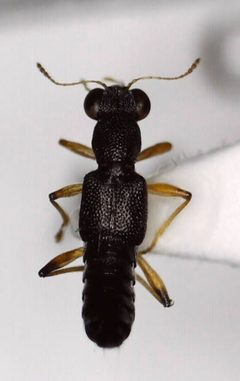
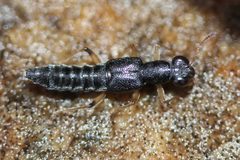
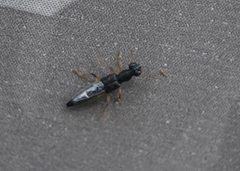
Stenus flavicornis is a of rove beetle in the Steninae, commonly referred to as a water skater. It was described by Erichson in 1840 and is native to North America. Members of the Stenus are known for their ability to glide on water surfaces using specialized gland secretions that reduce surface tension. Some species in this genus are also notable for their unique prey-capture mechanism involving eversible mouthparts.
Pronunciation
How to pronounce Stenus flavicornis: /ˈstɛ.nus flæˈvɪ.kɔr.nɪs/
These audio files are automatically generated. While they are not always 100% accurate, they are a good starting point.
Identification
Images
Distribution
Recorded from Canada (British Columbia, Manitoba, New Brunswick, Newfoundland and Labrador, Nova Scotia, Ontario, Prince Edward Island, Quebec, Saskatchewan) and the United States (Alabama, California, Connecticut, District of Columbia, Delaware, Florida, Georgia, Iowa, Illinois, Indiana, Kansas, Kentucky, Massachusetts, Maryland, Maine, Michigan, Minnesota, Missouri, North Carolina, North Dakota, New Hampshire, New Jersey, New York, Ohio, Pennsylvania, Rhode Island, South Dakota, Tennessee, Texas, Virginia, Vermont, Wisconsin, West Virginia, Wyoming).
Similar Taxa
- Stenus liupanshanusBoth belong to Stenus and share the Steninae characteristics, though S. liupanshanus inhabits leaf litter and reportedly lacks water-gliding ability, unlike some other Stenus .
- Stenus biwenxuaniBoth are Stenus ; S. biwenxuani was found on shore and is considered a water glider, potentially sharing preferences with S. flavicornis.
- Dianous speciesDianous and Stenus are both in Steninae with water-gliding representatives, though Dianous are reportedly more specialized for this than many Stenus species.
More Details
Taxonomic Status Note
Catalogue of Life lists Stenus flavicornis as a synonym of Stenus (Hypostenus) flavicornis Erichson, 1840. GBIF and NCBI treat it as an accepted . This taxonomic ambiguity reflects ongoing revisions within the large and complex Stenus.