
Ocypus nitens
(Schrank, 1781)
Ocypus nitens is a large, rove beetle in the Staphylinidae, Staphylininae, native to Central Europe and now established in eastern North America. First reported from the Americas in 1944, it remained restricted to New England for decades before rapidly expanding its range after 2000. The was first detected in Canada in 2016 through citizen science contributions to BugGuide, representing the first Canadian record. It is among the largest and most conspicuous rove beetles in its introduced range, making it relatively easy to detect.


Pronunciation
How to pronounce Ocypus nitens: //ˈɔsɪpʊs ˈnaɪtɛnz//
These audio files are automatically generated. While they are not always 100% accurate, they are a good starting point.
Identification
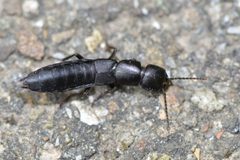
Distinguished from other Nearctic rove beetles by its large size (12–20 mm), relatively short forewings, and characteristic shape. The combination of large body size and conspicuous appearance separates it from most native Staphylinidae in its introduced range. Verification of identification is recommended through comparison with reference specimens or expert confirmation, particularly given its recent arrival in new regions.
Images
Appearance
A large rove beetle measuring 12–20 mm in length. The forewings () are relatively short, exposing most of the —a characteristic feature of Staphylinidae. The has a characteristic form that aids in identification. The body is robust and conspicuous compared to most rove beetles.
Habitat
Found in maple-beech forest, leaf litter, under loose bark on white pine logs, under porch lights, on house siding, inside houses, under rocks at field edges, on ocean beaches under driftwood, and on country roads. Shows affinity for human-modified environments including woodlots and backyards.
Distribution
Native to Central Europe; introduced to North America. Nearctic distribution includes: Canada (Ontario, New Brunswick), USA (Vermont, Maine, Massachusetts, New Hampshire, New York, Rhode Island). First Canadian record from Peel County, Ontario in 2016; first Vermont record from Windsor County. Range has expanded significantly since 2000 after being restricted to New England since 1944.
Behavior
Frequently observed near human habitation, including under porch lights and inside houses. Attracted to artificial light sources. Active in leaf litter and under bark. The ' conspicuous nature and large size make it readily detectable compared to most rove beetles.
Human Relevance
An introduced to North America through transatlantic trade, likely transported accidentally in produce or other goods. First reported from the Americas in 1944. Its recent rapid range expansion has been documented through citizen science platforms, particularly BugGuide. The impact on native rove beetle is unknown, though observations suggest some related native species have declined in abundance since the early 2000s. The species' detection demonstrates the value of citizen-generated distributional data for tracking insect spread.
Similar Taxa
- Native Nearctic Ocypus speciesNative in the same may be confused with O. nitens, but O. nitens is distinguished by its larger size and specific .
- Other large StaphylinidaeOther large rove beetles in the region are generally smaller than O. nitens or have different body proportions and length.
More Details
Citizen science detection
The first Canadian record was identified from a single pinned specimen, with subsequent distribution data confirmed from 26 verified digital photographs submitted by citizen scientists to BugGuide.net. This represents a significant example of public-generated data contributing to detection.
Range expansion timeline
The was first recorded in North America in 1944, remained restricted to a small area in New England for over 50 years, then began rapid range expansion around 2000. This pattern suggests a lag phase followed by ecological release or climate-facilitated spread.
Sources and further reading
- BugGuide
- Wikipedia
- GBIF taxonomy match
- iNaturalist taxon
- NCBI Taxonomy
- citizen science | Blog - Part 4
- Coleoptera | Blog - Part 3
- entomology | Blog - Part 14
- Biodiversity Data Journal | Blog - Part 14
- First detection of the adventive large rove beetle Ocypus nitens (Schrank) in Canada and an update of its Nearctic distribution using data generated by the public
- Figure 1 from: Brunke A (2016) First detection of the adventive large rove beetle Ocypus nitens (Schrank) in Canada and an update of its Nearctic distribution using data generated by the public. Biodiversity Data Journal 4: e11012. https://doi.org/10.3897/BDJ.4.e11012
- Figure 2 from: Brunke A (2016) First detection of the adventive large rove beetle Ocypus nitens (Schrank) in Canada and an update of its Nearctic distribution using data generated by the public. Biodiversity Data Journal 4: e11012. https://doi.org/10.3897/BDJ.4.e11012