
Ocypus
Leach, 1819
Species Guides
3- Ocypus aeneocephalus
- Ocypus nitens
- Ocypus olens(Devil's Coach-horse Beetle)
Ocypus is a of rove beetles in the Staphylininae, containing approximately 176 described distributed across the Palearctic, Nearctic, and Oriental regions. The genus includes the well-known Ocypus olens (devil's coach-horse ), a large, predatory species with documented potential for of pest snails. Several species have been introduced outside their native ranges, including O. nitens, which has established in North America and shown rapid range expansion. The genus exhibits considerable diversity in China, with numerous species described from Sichuan, Gansu, Yunnan, and other provinces.
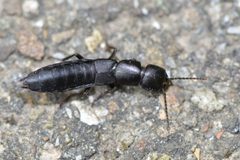
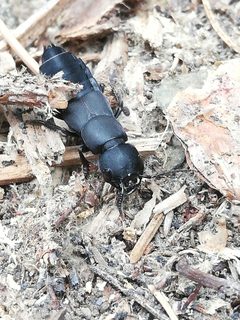
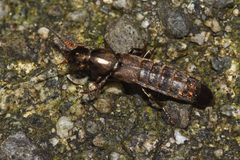
Pronunciation
How to pronounce Ocypus: //ˈo.sɪ.pʊs//
These audio files are automatically generated. While they are not always 100% accurate, they are a good starting point.
Identification
Ocypus are generally medium to large rove beetles (12–25 mm), characterized by their elongated body form, relatively short that leave much of the exposed, and prominent . The can be distinguished from similar rove beetle genera by features of the and the structure of the and pronotum. Species-level identification often requires examination of male genitalia. Ocypus nitens is distinguished by its characteristic head shape and relatively short forewings. A tabular key to Nearctic species is available.
Images
Habitat
vary by . Ocypus curtipennis occupies oak-ash-maple forest litter, superficial soil layers, and moist microhabitats under stones; it is also , inhabiting nests and burrows of small mammals. Ocypus olens occurs in agricultural and residential areas in California. Many Chinese species are associated with montane forests in Sichuan, Gansu, and other provinces. Ocypus nitens is frequently observed in woodlots and backyards near human habitation.
Distribution
Palearctic, Nearctic, and Oriental regions. Native distribution includes Europe, Asia (China, Japan, Russian Far East, Middle East), and North Africa. Ocypus olens is established in California, USA. Ocypus nitens, native to the Palearctic, has been introduced to North America with records from New England, Ontario (Canada), and Vermont (USA). Ocypus curtipennis occurs in Crimea, Bulgaria, France, Turkey, Cyprus, Syria, Iran, Iraq, Russia, and Moldova.
Seasonality
Ocypus curtipennis is active from March to October, with and larvae hibernating. Ocypus nitens has been observed year-round in its introduced North American range, with peak activity periods likely corresponding to warmer months.
Diet
Predatory. Ocypus olens consumes brown garden snails (Helix aspersa), with a female observed eating 20 small snails in 22 days—nearly its body weight daily. Ocypus curtipennis preys on various insects and snails. The as a whole functions as in soil and litter .
Life Cycle
Holometabolous development typical of Coleoptera. Ocypus curtipennis and larvae hibernate, initially constructing a protective "nest" for this period. Detailed information for most is lacking.
Behavior
Ocypus curtipennis exhibits cryptobiont and is strongly attracted to moisture. Ocypus olens demonstrates high predatory on snails under laboratory conditions. Field observations suggest O. olens can reduce local snail . Ocypus nitens is conspicuous and readily observed near human habitation.
Ecological Role
in soil and litter , contributing to regulation of including pest snails and other insects. Ocypus olens has demonstrated potential as a agent for the agricultural and residential pest Helix aspersa.
Human Relevance
Ocypus olens has been investigated for of the brown garden snail (Helix aspersa), a serious agricultural and residential pest in California. Ocypus nitens is an in North America whose impact on native rove beetle remains unknown; some related beetles have shown population declines coinciding with its expansion. The devil's coach-horse (O. olens) has cultural significance in European folklore, associated with the devil and superstitions dating to the Middle Ages.
Similar Taxa
- StaphylinusHistorically confused with Ocypus; distinguished by genital and body proportions. Some formerly placed in Ocypus have been transferred to Staphylinus or other .
- TasgiusSimilar large rove beetles in Staphylininae; separation based on structure and other morphological features.
More Details
Taxonomic history
The has undergone extensive revision, with many transferred among subgenera. The subgenus Pseudocypus contains multiple lineages (picipennis-, fuscatus-, and semenowi-lineages) with numerous species described from China since 2005.
Citizen science contributions
Ocypus nitens distribution in North America has been documented primarily through citizen-generated photographs on BugGuide, demonstrating the value of public participation in tracking .
Conservation status
No in the are currently considered threatened; most are widespread and adaptable.
Sources and further reading
- BugGuide
- Wikipedia
- GBIF taxonomy match
- iNaturalist taxon
- NCBI Taxonomy
- Catalogue of Life
- citizen science | Blog - Part 4
- Folklore and Myth: The Invertebrate Edition - Buglife Blog - Buglife
- What are the benefits of slugs and snails? - Buglife Blog - Buglife
- Coleoptera | Blog - Part 3
- entomology | Blog - Part 14
- Biodiversity Data Journal | Blog - Part 14
- Ocypus Curtipennis Motschulsky, 1849 (Coleoptera, Staphylinidae, Staphylininae) - specie nouă în fauna Republicii Moldova
- A ROVE BEETLE, OCYPUS OLENS, WITH POTENTIAL FOR BIOLOGICAL CONTROL OF THE BROWN GARDEN SNAIL, HELIX ASPERSA, IN CALIFORNIA, INCLUDING A KEY TO THE NEARCTIC SPECIES OF OCYPUS
- Figure 1 from: Brunke A (2016) First detection of the adventive large rove beetle Ocypus nitens (Schrank) in Canada and an update of its Nearctic distribution using data generated by the public. Biodiversity Data Journal 4: e11012. https://doi.org/10.3897/BDJ.4.e11012
- First detection of the adventive large rove beetle Ocypus nitens (Schrank) in Canada and an update of its Nearctic distribution using data generated by the public
- Morphology of Immature Stages and Notes on Biology ofOcypus fulvipennisErichson, 1840 (Coleoptera: Staphylinidae)
- Figure 2 from: Brunke A (2016) First detection of the adventive large rove beetle Ocypus nitens (Schrank) in Canada and an update of its Nearctic distribution using data generated by the public. Biodiversity Data Journal 4: e11012. https://doi.org/10.3897/BDJ.4.e11012
- Contributions to the knowledge of the Staphylinus-complex (Coleoptera: Staphylinidae: Staphylinini) of China. Part 21. The genus Ocypus Leach, 1819, subgenus Pseudocypus Mulsant & Rey, 1876. Section 4
- Contributions to the knowledge of the “Staphylinus-complex” (Coleoptera: Staphylinidae: Staphylinini) of China. Part XX. The genus Ocypus Leach, 1819, subgenus Pseudocypus Mulsant & Rey, 1876. Section 1
- PREDATORY BEHAVIOUR ON GROUND BEETLES (COLEOPTERA: CARABIDAE) BY OCYPUS OLENS (MÜLLER) (COLEOPTERA: STAPHYLINIDAE) UNDER LABORATORY CONDITIONS