
Philonthus cognatus
Stephens, 1832
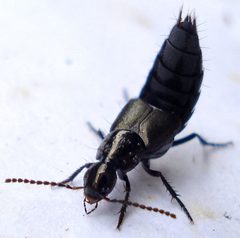
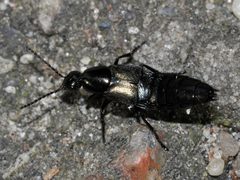
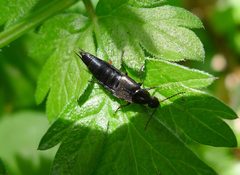
Philonthus cognatus is a relatively large rove beetle (8–11 mm) in the Staphylinidae. Native to the western Palearctic, it has been introduced to North America where it is now established in the USA and Canada. are primarily black with metallic bronze or greenish and a distinctive yellow underside to the first antennal segment. The is an important of agricultural pests, particularly aphids.
Pronunciation
How to pronounce Philonthus cognatus: //fɪˈlɒnθəs kɒɡˈneɪtəs//
These audio files are automatically generated. While they are not always 100% accurate, they are a good starting point.
Identification
The yellow underside of the first antennal segment is the key distinguishing feature from similar Philonthus . The metallic sheen on the and profuse pitting are additional supporting characters. are larger than many (8–11 mm vs. typically smaller in related species).
Images
Appearance
are 8–11 mm long. Body is mainly black with exhibiting a metallic bronze or greenish sheen and profuse pitting. The underside of the first antennal segment is yellow, contrasting sharply with the black upperside—this is a distinctive diagnostic feature. Some individuals may show variation in the intensity of metallic coloration.
Habitat
Damp soils in woodland and grassland . Collected from woodland by soil potting methods. In Britain, described as a common .
Distribution
Widespread across the UK and western Palearctic (Europe, North Africa, Turkey, Iran, Central Asia). Introduced to North America in the 19th century; currently established in Canada (Alberta, British Columbia, New Brunswick, Newfoundland, Nova Scotia, Ontario, Prince Edward Island, Quebec) and throughout the USA.
Seasonality
Two peaks in abundance: spring to early summer (March–June) and autumn (August–October). Adults present year-round. Breeding occurs in late spring to early summer.
Diet
of agricultural pests, particularly aphids.
Life Cycle
Breeding takes place in late spring to early summer. Two or activity peaks suggested by bimodal abundance pattern.
Behavior
Possesses defensive glands producing complex chemical secretions used for defense or with antimicrobial activity. are active .
Ecological Role
Important of agricultural pests such as aphids, contributing to in agricultural and natural .
Human Relevance
Beneficial insect in agricultural contexts due to . Subject of sequencing research (Wellcome Sanger Institute, 2023).
Similar Taxa
- Philonthus caeruleipennisSimilar size and metallic coloration, but P. caeruleipennis has blue-green and lacks the yellow antennal underside characteristic of P. cognatus; also has more restricted North American distribution (northeast quarter of USA and Canada)
More Details
Genome Resources
sequenced by the Darwin Tree of Life project; assembly spans 1,030.6 Mb with 12 chromosomal pseudomolecules including X and Y , and a 20.7 kb mitochondrial genome. Gene annotation identified 29,629 protein-coding genes.
Taxonomic Note
Authorship sometimes cited as Sharp, 1876 in some sources, but Stephens, 1832 is the accepted original authority per NCBI and modern taxonomic databases.
Sources and further reading
- BugGuide
- Wikipedia
- GBIF taxonomy match
- iNaturalist taxon
- NCBI Taxonomy
- Catalogue of Life
- A Buggy New Year! | Bug Squad
- Bug Eric: Fungus Party-y-y!
- Bug Eric: More Beetles from Bones
- Bug Eric: 2022
- Mantispidae | Beetles In The Bush
- The genome sequence of Philonthus cognatus (Stephens, 1832) (Coleoptera, Staphylinidae), a rove beetle.