
Gabronthus thermarum
(Aubé, 1850)
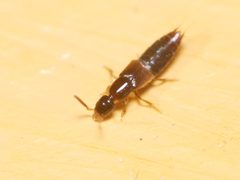
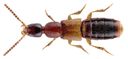
Gabronthus thermarum is a rove beetle (Staphylinidae) originally described from Europe in 1850. The has become widely distributed through human activity, with established across the Palearctic region and numerous introductions to the Americas, Africa, Asia, and Oceania. It is frequently associated with warm, moist environments including compost, manure, and decomposing organic matter. Its successful global spread makes it one of the more broadly distributed members of the Gabronhus.
Pronunciation
How to pronounce Gabronthus thermarum: /ɡæbˈrɒnθəs ˈθɜːrɑːrəm/
These audio files are automatically generated. While they are not always 100% accurate, they are a good starting point.
Identification
Distinguished from other Gabronthus and similar staphylinines by genitalia , particularly the structure, which requires microscopic examination. The species name 'thermarum' (Latin: of warm baths) hints at its thermal preference, though this alone is not diagnostic. Accurate identification typically requires reference to specialized taxonomic keys for the Philonthina subtribe and comparison with or authoritative descriptions.
Images
Habitat
Warm, moist environments rich in decomposing organic matter. Documented from compost, manure heaps, decaying plant material, and similar substrates. The shows preference for elevated temperatures and humid conditions.
Distribution
Native to the Palearctic region (Europe, including Azores). Widely introduced and established across multiple continents: North America (Canada, USA, Mexico), Central America ( Rica), Caribbean (Jamaica, Hispaniola, Puerto Rico, Lesser Antilles, Guadeloupe), South America (French Guiana), Africa (Zaire, South Africa, Mascarenes, Seychelles), Asia (Japan, Nepal, India, Taiwan, China), and Oceania (Australia, New Caledonia). Also recorded from São Miguel in the Azores.
Diet
Predatory and/or saprophagous on decomposing organic matter; specific feeding habits not well documented
Ecological Role
Contributes to decomposition processes in warm, moist organic substrates. Likely functions as a of small and/or scavenger in these environments, though specific ecological impacts are not well studied.
Human Relevance
distribution strongly suggests human-mediated , likely through transport of compost, manure, and organic materials in agriculture and horticulture. No documented economic importance as pest or beneficial . Presence in compost systems indicates potential role in waste decomposition processes.
Similar Taxa
- Gabronthus speciesOther members of the share similar general ; definitive separation requires examination of male genitalia and detailed morphological comparison
- Philonthus speciesFormerly classified in Philonthus; closely related in this subtribe share abbreviated and general staphylinine body plan, requiring careful taxonomic study to distinguish
More Details
Nomenclatural history
Originally described as Philonthus thermarum by Aubé in 1850, later transferred to Gabronthus. The basionym Philonthus thermarum remains in taxonomic literature.
Invasion biology
The extensive non-native range across six continents indicates this is a successful colonizer, though it has not been formally studied as an . Its association with compost and organic waste suggests repeated introduction via agricultural and horticultural trade.