
Cafius bistriatus
(Erichson, 1840)
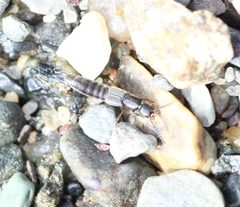
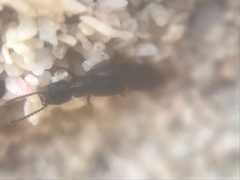
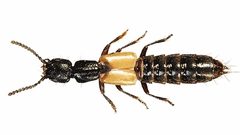
Cafius bistriatus is a relatively large rove beetle in the Staphylinidae, reaching up to 7 mm in length. The exhibits a transcontinental distribution in the Americas, occurring along both Atlantic and Pacific coastlines from Canada to northern South America, with extensive Caribbean island records. Two are recognized: C. b. bistriatus (Atlantic and Gulf coasts, Caribbean) and C. b. fulgens (Pacific coasts including the Gulf of California and Salton Sea).
Pronunciation
How to pronounce Cafius bistriatus: //ˈkeɪ.fi.us bɪˈstraɪ.ə.tus//
These audio files are automatically generated. While they are not always 100% accurate, they are a good starting point.
Identification
Distinguished from other Cafius by the combination of large size (up to 7 mm) and transverse distribution pattern. identification requires geographic origin: Atlantic/Gulf/Caribbean specimens are C. b. bistriatus; Pacific coast specimens are C. b. fulgens. The subspecies C. b. fulgens was described based on coastal versus inland Salton Sea .
Images
Appearance
Relatively large rove beetle, reaching up to 7 mm in length. As a member of Staphylinidae, it has the characteristic short exposing most of the . The specific epithet 'bistriatus' (two-striped) suggests paired longitudinal markings, though detailed morphological description is not provided in sources.
Habitat
Coastal and near-coastal environments. Found along shorelines of Atlantic Ocean, Gulf of Mexico, Caribbean Sea, and Pacific Ocean. The C. b. fulgens occupies Pacific coastal including the Salton Sea, an inland saline lake in California.
Distribution
North America: Quebec, Newfoundland, New Brunswick, Nova Scotia, Prince Edward Island (Canada); USA from Maine to Florida (absent from South Carolina and Georgia), Texas, California; Mexico (Veracruz, Campeche, Quintana Roo, Baja California Norte, Baja California Sur, Guerrero, Sonora); Bermuda; Bahamas; Caribbean (Antigua, Barbados, Dominica, Dominican Republic, Carriacou, Guadeloupe, Jamaica, Montserrat, Puerto Rico including Mona, St. Kitts, St. Lucia, Trinidad, Tobago, U.S. Virgin Islands—St. Thomas); Venezuela (Falcón state).
Similar Taxa
- Other Cafius speciesC. bistriatus is distinguished by its relatively large size (up to 7 mm) compared to , and by its distinctive transcontinental distribution with recognized coastal .
More Details
Subspecies
Two recognized based on geographic separation: C. b. bistriatus (Erichson, 1840) occupies Atlantic, Gulf of Mexico, and Caribbean coasts; C. b. fulgens Frank, 1986 occupies Pacific coasts from California to Mexico including the Gulf of California and Salton Sea.
Taxonomic history
Originally described as Philonthus bistriatus Erichson, 1840, with synonym Philonthus bilineatus Erichson, 1840. Transferred to Cafius. The Pacific was described by Frank in 1986 based on material from the Salton Sea and Pacific Mexico.