
Cafius
Stephens, 1829
coastal rove beetles
Species Guides
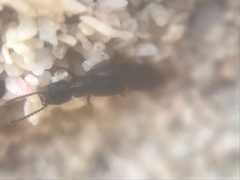
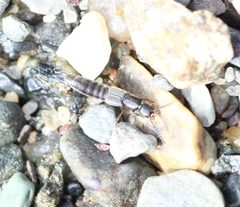
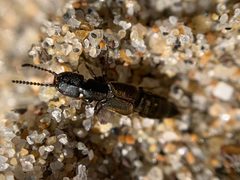
8Cafius is a of relatively large rove beetles in the Staphylinidae, comprising approximately 8 described in North America and approaching 50 globally. The genus originated in the early Miocene (ca. 17.91 Ma) along the coasts of Europe and Australia, with subsequent diversification driven by transoceanic via ocean surface currents. Species are obligate inhabitants of coastal marine environments, particularly sandy intertidal zones. The genus is notable for its global distribution across temperate and tropical coastlines and its biological adaptations to saline, dynamic shoreline .
Pronunciation
How to pronounce Cafius: /ˈka.fi.us/
These audio files are automatically generated. While they are not always 100% accurate, they are a good starting point.
Identification
Large-bodied rove beetles (Staphylinidae) distinguished from related by coastal marine specialization combined with relatively large size. Specific diagnostic morphological features for genus-level identification require examination of mouthparts, tarsal structure, and male genitalia; -level identification often necessitates dissection and reference to taxonomic revisions.
Images
Habitat
Strictly coastal marine environments, primarily sandy intertidal beaches and drift lines. and larvae occur in sand beneath seaweed, marine debris (wrack), and decaying organic matter deposited at the high tide line. Some extend to rocky shorelines.
Distribution
Global distribution across temperate and tropical coastlines. Origin in early Miocene along coasts of Europe and Australia; subsequently colonized coasts worldwide via transoceanic . Documented from North America, Europe (including Britain, France, Scandinavia), Australia, and Asia (China).
Diet
Predatory. Larvae feed on small in beach debris, including dipteran larvae and other small arthropods. feeding habits assumed similar but less documented.
Life Cycle
Complete : , two larval instars, pupa, . Eggs laid in sand or among beach debris in intertidal zone. Larvae pass through multiple instars before ; pupation occurs in sand. Developmental stages described for C. nauticus (China) and four North American (C. bistriatus, C. canescens, C. fulvipes, C. xantholoma).
Behavior
activity. Rapid burrowing in sand. to saline conditions and periodic inundation. and larvae aggregate in beach wrack and under seaweed. Intra- and interspecific interactions documented in C. nauticus.
Ecological Role
in intertidal sandy beach . Contributes to decomposition of marine organic matter (wrack) by preying on associated .
Similar Taxa
Sources and further reading
- BugGuide
- Wikipedia
- GBIF taxonomy match
- iNaturalist taxon
- NCBI Taxonomy
- Catalogue of Life
- Cafius bistriatus(Coleoptera: Staphylinidae), Distributional Range Extension to North Carolina
- Descriptions of the developmental stages of Cafius nauticus (Fairmaire) (Coleoptera: Staphylinidae: Staphylininae), with comments on its biology
- The Larval And Pupal Stages Of 4 Species Of Cafius Coleoptera Staphylinidae With Notes On Their Biology And Ecology
- A Taxonomic Review of Coastal Cafius algarum (Sharp) (Coleoptera: Staphylinidae) with Two New Synonyms and Discussion of Its Distributional Extension
- Global diversification of coastal Cafius rove beetles (Coleoptera: Staphylinidae) driven by ocean currents since the early Miocene
- A total-evidence approach resolves phylogenetic placement of ‘Cafius’ gigas,a unique recently extinct rove beetle from Lord Howe Island
- Integrative taxonomy of coastal Cafiusbistriatus (Erichson) species complex (Coleoptera, Staphylinidae).