
Scaphisoma convexum
Say, 1825
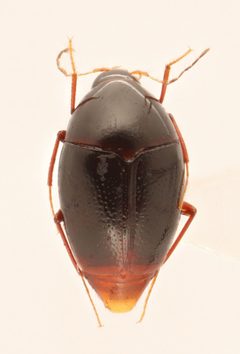
Scaphisoma convexum is a of rove beetle in the Scaphidiinae, characterized by its small, convex body form that distinguishes it from the typically more elongate staphylinids. The species was described by Thomas Say in 1825 and represents one of the more widely distributed members of its in North America. Like other members of Scaphidiinae, it is associated with fungal . The species shows substantial geographic range across eastern and central North America with scattered western records.
Pronunciation
How to pronounce Scaphisoma convexum: /ˌskæfɪˈsoʊmə kənˈvɛksəm/
These audio files are automatically generated. While they are not always 100% accurate, they are a good starting point.
Identification
The convex, rounded body profile is diagnostic for the Scaphisoma and distinguishes S. convexum from the vast majority of Staphylinidae, which are elongate and flattened. Within Scaphisoma, -level identification requires examination of genitalic structures and fine details of punctation and elytral microsculpture. S. convexum can be separated from the similar S. agaricinum by differences in male genitalia and subtle body proportions. The combination of small size, strongly convex dorsum, and short is distinctive at the level.
Images
Appearance
Small with a distinctly convex, rounded body profile. Body form is compact and somewhat humped, differing from the elongated, flattened shape typical of most rove beetles. are relatively short. are abbreviated, exposing several abdominal tergites. Coloration is generally dark, often with reddish or yellowish tones. Size is minute, typical for the .
Habitat
Associated with fungal fruiting bodies, particularly mushrooms and bracket fungi in forested environments. Found in decaying wood and other substrates supporting fungal growth. Occurs in both coniferous and deciduous forests.
Distribution
Eastern and central North America: Canada (Manitoba, New Brunswick, Nova Scotia, Ontario, Quebec) and USA (Alabama, Arkansas, Arizona, Connecticut, District of Columbia, Florida, Georgia, Indiana, Louisiana, Massachusetts, Maryland, Maine, Michigan, Missouri, North Carolina, New Hampshire, New York, Oklahoma, Pennsylvania, Rhode Island, Texas, Virginia, Vermont). The Arizona and Oklahoma records represent western extensions of the primary eastern range.
Seasonality
have been recorded from March through November, with peak activity in summer months. Activity patterns likely track fungal fruiting .
Diet
Mycophagous; feeds on fungal tissues.
Host Associations
- Fungi - food sourceSpecific fungal not documented for this
Ecological Role
Decomposer; contributes to nutrient cycling through consumption of fungal in forest .
Human Relevance
No direct economic or medical significance. Occasionally encountered by mushroom collectors and entomologists.
Similar Taxa
- Scaphisoma agaricinumOverlapping distribution and ; distinguished by male genitalia and subtle differences in body shape and punctation
- Other Staphylinidae (subfamily Staphylininae, etc.)Most rove beetles are elongate and flattened; Scaphisoma are immediately recognizable by their convex, rounded profile
More Details
Taxonomic note
Scaphidiinae, sometimes treated as the Scaphidiidae, represents a distinctive lineage within Staphylinoidea. The is universally mycophagous and exhibits morphological adaptations for this lifestyle, including the compact, convex body form seen in Scaphisoma.